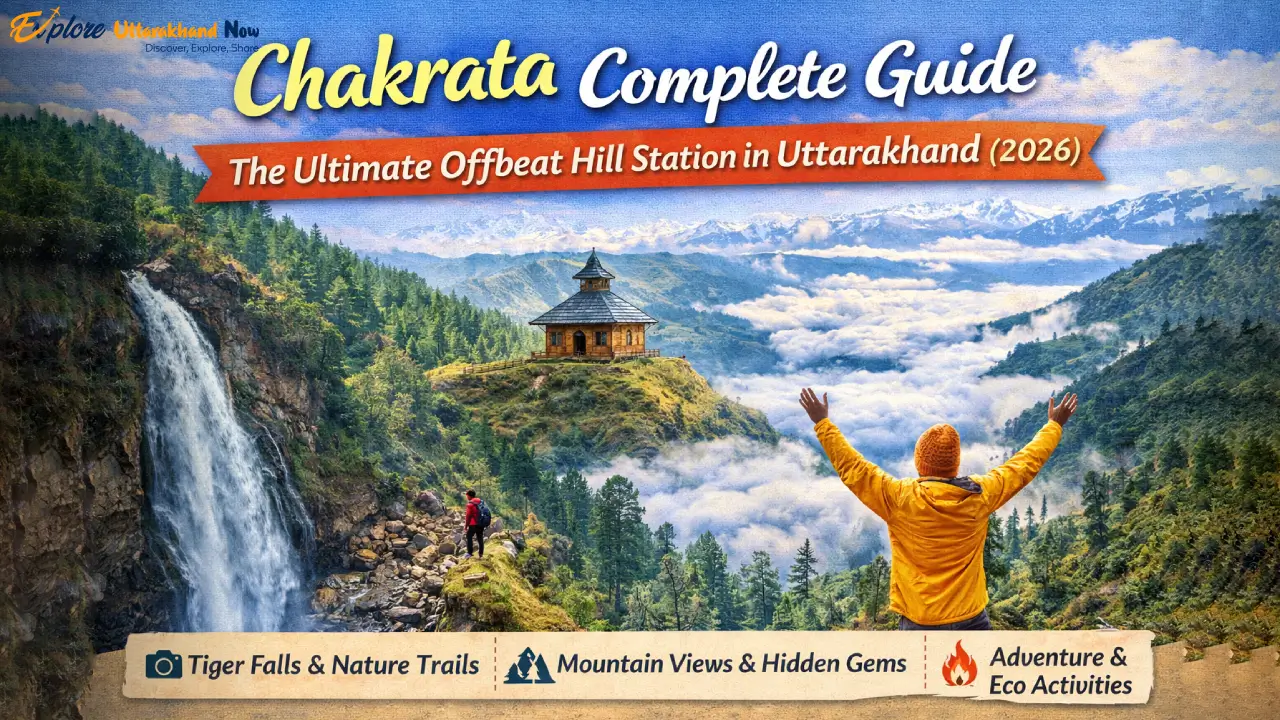
Chakrata: India’s Best-Kept Mountain Secret
There is a particular thrill that comes from discovering a place that feels like it exists outside the tourist machine — where the pine forest is genuinely quiet, the air is genuinely cold, and you can sit on a ridge at dusk watching the Himalayas turn orange without fighting a crowd for your view. Chakrata is that place.
A secluded cantonment town tucked in the Jaunsar-Bawar region of Uttarakhand’s Dehradun district, Chakrata sits at an altitude of 2,118 metres (6,949 ft) on a ridge between the Tons and Yamuna rivers. It is one of the few hill towns in northern India where development has moved slowly enough that the natural landscape still dominates — dense forests of oak, rhododendron, and deodar cedar covering the hillsides, undisturbed waterfalls plunging through pristine gorges, and ancient temples where the priests outnumber the tourists.
While the name Chakrata is unfamiliar to many travellers, those in the know have quietly prized it for years. It regularly features among the top offbeat hill stations in India precisely because of what it lacks: the honking taxis, the souvenir clutter, the cable cars to overcrowded viewpoints. What it has instead is something far rarer — genuine, unhurried wilderness within a day’s drive of Delhi.
There is one logistical reality to understand before planning your trip: Chakrata is an active military cantonment administered by the Indian Army. This shapes the town’s character in largely positive ways — it is extraordinarily safe, well-maintained, and orderly — but it does mean that non-Indian citizens require a special permit to enter. We cover this in detail later in this guide.
This Chakrata travel guide covers everything — from the top 10 places to visit and things to do, to weather, logistics, food, and a full FAQ section. Whether you’re planning a weekend escape from Dehradun or a longer mountain immersion, Chakrata is ready to surprise you.
Top 10 Places to Visit in Chakrata
Here are the ten experiences that define a complete Chakrata journey — from thundering waterfalls to prehistoric caves to panoramic Himalayan viewpoints.
Tiger Falls — The Jewel of the Jungle
At 312 feet (approximately 95 metres), Tiger Falls is one of the highest and most spectacular waterfalls in Uttarakhand — and almost certainly the most dramatic single natural feature in the Chakrata region. The waterfall plunges in an unbroken curtain of white water through a narrow, forested gorge, landing in a cold emerald pool surrounded by mossy rocks and cedar trees that block out the sky.
The access route is itself part of the experience: a 5-kilometre forest trek from the road end that passes through one of the most beautiful stretches of mixed forest in this part of Uttarakhand. The path is well-marked and manageable for most fitness levels, making Tiger Falls one of Chakrata’s most rewarding outings. For a complete breakdown of the trek route, best visiting conditions, entry details, and what to bring, read our dedicated Tiger Falls essential guide.
- Distance from Chakrata: ~20–25 km by road + 5 km forest trek
- Best season: March to June for full flow; avoid monsoon season (July–September) for safety
- Tip: Start the trek by 8 AM on weekdays to have the falls almost entirely to yourself
Budher Caves — Into the Prehistoric Dark
One of Chakrata’s most intriguing and physically demanding attractions, the Budher Caves (also written as Budhir or Badhani) are a network of limestone caverns hidden inside the dense Budher Forest, roughly 30 km from Chakrata town. These are not tourist caves fitted with handrails and coloured lights — they are raw, ancient, naturally formed chambers that require crawling, squeezing, and navigating with torches.
The caves are believed to be geologically significant and are associated in local legend with the Pandavas of the Mahabharata, who are said to have sheltered here during their years of exile. The surrounding forest — ancient, dense, and almost entirely undisturbed — makes the journey to the caves as memorable as the caves themselves. This is genuine offbeat adventure territory: bring a guide, a headlamp, and a spirit of exploration.
- Distance: ~30 km from Chakrata; accessible by road followed by a forest walk
- Essential: Hire a local guide — the cave network is disorienting without one
- Best for: Adventure travellers, history enthusiasts, fit hikers
Chilmiri Neck — Sunrise From the Roof
The highest accessible point in the Chakrata area at 2,470 metres, Chilmiri Neck is the classic viewpoint that most visitors prioritise — and for good reason. On a clear morning, the panoramic view from the summit encompasses an extraordinary sweep of the Garhwal Himalayas, including Bandarpunch, Swargarohini, and on exceptionally clear days in winter, the distant white crown of Kedarnath.
The viewpoint is just 2 km from Chakrata town — a short hike through the cantonment’s cedar forest that can be done in under an hour. The path is easy, well-defined, and especially magical in winter when the cedar branches carry fresh snow. Chilmiri Neck is the obvious choice for sunrise, when mist fills the valleys below and the peaks catch the first light.
- Distance from town: ~2 km; 45–60 minute easy hike
- Best time: 1 hour before sunrise; carry a warm layer regardless of season
Deoban — Forests, Birds & Himalayan Horizons
Deoban — literally “forest of deodars” — is a high-altitude forest area about 13 km from Chakrata, at an elevation of around 2,200–2,500 metres. It is arguably the most beautiful forest landscape in the entire Chakrata region: vast stands of ancient deodar cedars with their silver-grey trunks and drooping branches creating a cathedral-like atmosphere, broken by open meadows with views across to the snow peaks.
Deoban is one of Uttarakhand’s premier birdwatching destinations. The dense mixed forest supports extraordinary avian diversity — Himalayan monal (the state bird), koklass pheasant, cheer pheasant, various laughingthrushes, nuthatches, treecreepers, and a rotating cast of migratory species during spring and autumn. Birders with a checklist and binoculars could spend an entire day here without running out of things to see and hear.
- Best for: Birdwatching, photography, forest walks, picnics
- Best season: April–June for resident and migratory species; October for clear skies
Ram Tal Horticultural Garden — Colour in the Hills
A pleasant and photogenic 3-km walk from Chakrata town, the Ram Tal Horticultural Garden is a terraced garden maintained by the Uttarakhand government, set around a small natural lake (“Tal” means lake) surrounded by forest. The garden is at its best from late March to May, when its rhododendrons, roses, and seasonal flowers are in full bloom against the backdrop of the cedar forest.
The lake is a peaceful spot for quiet reflection, and the garden’s gentle walking paths are ideal for families with young children or those looking for a relaxed morning walk rather than a strenuous trek. Small benches and viewpoints around the lake offer pleasant spots to sit with a book or a packed breakfast.
- Distance: ~3 km from Chakrata town; easy walking or short drive
- Entry fee: Nominal; maintained by the horticulture department
Vyas Shikhar — Sage Summit with Big Views
Vyas Shikhar (also called Byas Shikhar) is a sacred peak approximately 10 km from Chakrata, associated in Hindu mythology with the sage Vyas — the legendary composer of the Mahabharata. A small temple at the summit honours the sage, and the location is considered auspicious by local Jaunsari communities who make regular pilgrimages here.
For the non-pilgrim, Vyas Shikhar offers one of the best panoramic viewpoints in the region, with unobstructed 180-degree views of the Himalayan ranges to the north and the forested Tons River valley below. The trail to the summit passes through beautiful mixed forest, and the combination of spiritual significance and natural grandeur makes this a satisfying full-day excursion.
- Distance: ~10 km from Chakrata; trail through cedar forest
- Best for: Trekkers, spiritual travellers, panoramic photography
Kanasar — Pristine Forest & Asia’s Tallest Tree
Kanasar, about 20 km from Chakrata at an altitude of 2,250 metres, is one of the most serene forest camping destinations in the entire Garhwal-Jaunsar belt. The area is home to some of the oldest and largest deodar cedar trees in India — one of them is claimed to be among the tallest in Asia.
Kanasar has a designated forest rest house and camping ground, making it ideal for an overnight stay deeper in the wilderness. Waking up in a tent under the deodar canopy, with the sound of wind through the branches and no human noise whatsoever, is one of Chakrata’s defining experiences for those willing to venture beyond the town. The area also has good raptor and pheasant populations for birders.
- Distance: ~20 km from Chakrata; accessible by road
- Stay option: Forest rest house (book via Uttarakhand Forest Department in advance)
Lakhamandal Temple — Where Time Stands Still
About 60 km from Chakrata, en route to or from Chakrata via the Yamuna valley road, Lakhamandal Temple is a remarkable 8th–9th century Shiva complex that stands beside the Yamuna River near the town of Barkot. The temple compound contains hundreds of ancient stone Shiva lingams, figurines, and sculptures dating from the Gupta and early medieval periods, scattered across the temple precinct with a matter-of-fact abundance that would make any museum curator envious.
Associated in legend with the Mahabharata — this is said to be the site of the Laksha Griha (the house of lac that Duryodhana built to trap the Pandavas), Lakhamandal is historically significant and atmospherically extraordinary. The Yamuna here is narrow, fast-moving, and cold, and the combination of ancient stone, flowing river, and cedar hillsides creates an unusually powerful sense of place.
- Best combined with: A drive through the Yamuna Valley on arrival or departure day
- Entry: Free; Archaeological Survey of India protected site
Mahasu Devta Temple — The Divine Authority of the Hills
Deep in the Chakrata forests, Mahasu Devta Temple is one of the most revered shrines of the Jaunsari people — an indigenous community whose culture, language, and traditions are distinct from mainstream Garhwali and Kumaoni identities. Mahasu Devta is a powerful regional deity considered the supreme arbiter of justice and the guardian of these forested hills.
Visiting the Mahasu Devta temple is as much a cultural encounter as a religious one. The temple architecture, the votive offerings, the priests in traditional Jaunsari dress, and the sound of the temple bells against the forest silence create an experience that feels genuinely removed from the tourist circuit. Respect local customs, remove footwear, and approach with the curiosity and courtesy the place deserves.
- Best for: Cultural travellers, religious history enthusiasts
- Etiquette: Follow all temple customs; photography restrictions may apply inside the sanctum
Kimona Falls — The Untouched Cascade
Kimona Falls is one of Chakrata’s lesser-known waterfall gems — a beautiful multi-tiered cascade set in a narrow forest gorge about 17 km from town. Unlike Tiger Falls, which has become reasonably well-known among Uttarakhand travellers, Kimona Falls remains almost entirely off the tourist radar, which means you are likely to arrive to find nothing but water, forest, and birdsong.
The access trail to Kimona Falls is rougher and less defined than the Tiger Falls trek, making it more suitable for travellers with some trekking experience. The forest around the falls is particularly rich in birdlife and undergrowth species, and the falls themselves are most impressive between March and June, fed by snowmelt from the higher ridges.
- Distance: ~17 km from Chakrata; forest trail access
- Best for: Off-the-beaten-path adventure seekers, photographers
Unique & Offbeat Places in Chakrata
Moila Top — The Trekker’s High Point
Moila Top is Chakrata’s premier trekking destination — a high-altitude meadow and viewpoint at approximately 2,750 metres that sits above the main cantonment area and is accessible by a trail that winds through progressively thinner forest into open alpine terrain. The views from Moila Top on a clear day are genuinely breathtaking: the entire Garhwal Himalayan chain laid out from west to east, with Bandarpunch and Swargarohini dominating the northern skyline.
The trek to Moila Top typically takes 3–4 hours from Chakrata town and involves moderate-to-challenging ascent, especially in the final section above the treeline. In winter (December–February), the trail is snow-covered and requires appropriate footwear and cold-weather gear. The summit area is open, windswept, and utterly remote — there are no food stalls, no chai shops, no other people. Just the mountain.
- Trek duration: 3–4 hours ascent; 2–3 hours descent
- Difficulty: Moderate to challenging; suitable for reasonably fit hikers
- Essential: Hire a local guide, especially for winter or off-season treks
Budher Caves — Spelunking Through History
We introduced the Budher Caves in the Top 10 section, but they deserve further mention as Chakrata’s most genuinely offbeat experience. The caves are not widely promoted, not easily accessible, and not suitable for casual visitors — which is precisely what makes them special. They represent the kind of raw, unpackaged adventure that is increasingly rare in Indian hill tourism, and for the right traveller, they are Chakrata’s most memorable experience.
Plan a full day: the drive through the Budher Forest alone is worth the journey, with the ancient cedar and rhododendron trees creating a dense, hushed tunnel of green. Carry water, energy food, a powerful torch, and if possible, book a guide from Chakrata town the evening before. The caves themselves extend for several hundred metres, with chambers of varying size connected by passages that range from merely crouching-height to requiring a full crawl on hands and knees.
Things to Do in Chakrata
Chakrata’s things to do list rewards the active, the curious, and the contemplative in equal measure:
- Birdwatching in Deoban: Bring binoculars and a field guide to Himalayan birds. The deodar and mixed oak forests around Deoban support over 150 recorded species. Dawn and dusk are peak activity periods; a patient 2-hour walk will typically yield 15–25 species even for a non-specialist observer.
- Rappelling at Tiger Falls: For adrenaline seekers, several adventure operators from Dehradun offer guided rappelling sessions on the rock face beside Tiger Falls. The combination of the roaring waterfall, the forest gorge, and the physical challenge makes this one of the most exhilarating activities in the Garhwal foothills.
- Stargazing: Chakrata’s distance from major urban centres, combined with its ridge-top position and minimal light pollution, makes it one of the best stargazing locations within a weekend’s reach of Delhi. On a moonless night, the Milky Way is visible to the naked eye with extraordinary clarity. The open meadow at Chilmiri Neck is ideal; bring a blanket and a star map.
- Trekking to Moila Top: Covered above — the definitive Chakrata trek for those seeking real altitude and solitude.
- Village walks in Jaunsari communities: The villages around Chakrata belong to the Jaunsari people, whose culture — including their distinctive wooden architecture, dress, music, and multi-husband marriage tradition (linked to the Pandava heritage) — is fascinating and rarely encountered by outside visitors. Walking through villages like Dhanolta or Mundali with respectful curiosity is one of Chakrata’s most rewarding human experiences.
- Winter snow activities: When snow blankets the Chakrata ridge in December and January, the slopes around Chilmiri Neck and Moila Top transform into informal sledging and snowplay areas. It is not an organized ski resort — which is exactly part of its charm.
Chakrata Weather & Best Time to Visit
Understanding Chakrata’s seasonal character is essential for planning a satisfying trip. Here is your complete Chakrata weather breakdown:
| Season | Months | Temp Range | Conditions | Verdict |
|---|---|---|---|---|
| Spring | Mar – Apr | 8°C – 22°C | Blooming rhododendrons, clear skies | ⭐⭐⭐⭐⭐ |
| Summer | May – Jun | 15°C – 28°C | Warm & green, ideal trekking | ⭐⭐⭐⭐⭐ |
| Monsoon | Jul – Sep | 14°C – 22°C | Heavy rain, landslide risk | ⭐⭐ |
| Autumn | Oct – Nov | 5°C – 18°C | Crisp, post-rain freshness | ⭐⭐⭐⭐ |
| Winter | Dec – Feb | -4°C – 10°C | Heavy snow, some roads close | ⭐⭐⭐ |
Spring and Summer (March–June) are the golden months. The rhododendrons blaze red and pink across the hillsides from March into April, the forests are a brilliant green, temperatures are pleasant, and the skies are typically clear enough for excellent Himalayan views. This is the peak season for trekking, birdwatching, Tiger Falls visits, and outdoor activities of every kind. For a broader look at Uttarakhand’s best warm-weather escapes, see our guide to top summer destinations in Uttarakhand.
Winter (December–February) is Chakrata’s snow season. The town receives substantial snowfall, especially in January — which is the coldest month, with temperatures regularly dropping to -4°C or below at night. The snowscape is beautiful, the deodar forests become magical in fresh white, and the town sees far fewer visitors, creating an atmosphere of genuine wintry solitude. Road access can be disrupted during heavy snowfall, so keep flexibility in your plans and check road conditions before departure.
Avoid July–September: The monsoon brings heavy rainfall that can trigger landslides on the narrow mountain roads leading to and from Chakrata. The forest turns lush and dramatic, but the risk to road travel is real. If you must visit during monsoon, check road conditions carefully and avoid Budher Caves and Tiger Falls trek during or immediately after heavy rain.
Getting to Chakrata: Distances & Logistics
Chakrata Distance from Dehradun & Key Cities
| From | Distance | Drive Time | Route Notes |
|---|---|---|---|
| Dehradun | ~87 km | ~3.5 hrs | Via Vikasnagar – Kalsi – Chakrata road |
| Mussoorie | ~90 km | ~3.5 hrs | Via Kempty Falls road, scenic drive |
| Haridwar | ~145 km | ~5 hrs | Via Dehradun |
| Delhi | ~340 km | ~7–8 hrs | Via NH-58 through Dehradun |
| Tiger Falls (from Chakrata) | ~20–25 km | ~45 min | Road + 5 km forest trek |
Getting there: The most common approach is to take a train or bus to Dehradun and then hire a taxi or take a shared jeep to Chakrata (~3.5 hours via Vikasnagar and Kalsi). The road is scenic but winding — those prone to motion sickness should take appropriate precautions. No direct buses from Delhi to Chakrata exist; the route via Dehradun is the standard approach.
Nearest airports: Jolly Grant Airport, Dehradun (~90 km from Chakrata; taxis available to Chakrata directly, approx. ₹2,000–₹2,500).
Is Chakrata Safe to Visit?
Chakrata is one of the safest hill towns in Uttarakhand — a direct consequence of its status as an active military cantonment. The Indian Army presence means the town is well-maintained, properly lit, and effectively free from the petty crime and harassment that can affect more tourist-heavy destinations. Solo travellers, families, and couples all report feeling entirely comfortable here, at any hour.
The roads leading to Chakrata are narrow and mountainous — standard for Himalayan terrain — and should be driven carefully, especially at night. During monsoon season, road conditions can deteriorate rapidly; always check locally before setting out.
Important Note: Restrictions for Foreign Visitors
| 🔴 PERMIT REQUIRED — Non-Indian Citizens Must Read This |
| Chakrata is an active military cantonment and home to a base of the Special Frontier Force (SFF) — an elite, highly classified Indian paramilitary unit. |
| Due to the strategic and sensitive nature of the military installations in the area, non-Indian citizens (including foreign tourists and OCI cardholders) are REQUIRED to obtain a special Restricted Area Permit (RAP) before visiting. |
| The permit must be applied for well in advance through the District Magistrate’s office in Dehradun. |
| Attempting to enter Chakrata without the required permit is a serious offence and will result in being turned back at military checkpoints — or worse. |
| Indian citizens: No permits required. Standard entry and registration at checkpoints applies. |
| Always carry your ID (Aadhaar/Passport) — there are multiple checkpoints on the road to Chakrata. |
The Special Frontier Force (SFF), also known informally as Establishment 22, is one of India’s most elite and secretive paramilitary units, originally formed in 1962. Its presence in the Chakrata area explains the high level of security in and around the cantonment. For the average visitor this is entirely unobtrusive — you will simply pass through a checkpoint and register your vehicle and ID — but foreign travellers must ensure their paperwork is in order well before arrival.
Food in Chakrata: Honest Mountain Cooking
Chakrata’s food scene is defined by authentic Garhwali and Jaunsari cuisine — straightforward, nourishing, and made from locally grown ingredients that you cannot find on a restaurant menu in the city. This is not the place for fine dining; it is very much the place for the real thing.
- Sidku: The signature dish of the Jaunsari people — a thick, steamed bread made from wheat flour, often stuffed with lentil or seasoned hemp seed paste and served with ghee and local honey. It is warming, dense, and deeply satisfying in the mountain cold.
- Himalayan Rajma: The rajma (kidney beans) grown at altitude in the Tons River valley and surrounding hills is a completely different ingredient from the commercial kidney beans available in plains supermarkets — smaller, darker, and with an intensity of flavour that makes a simple rajma-chawal here unforgettable. Do not leave without eating it.
- Mandua ki Roti: Flatbread made from mandua (finger millet), a traditional Garhwali grain. Dark, slightly nutty, and nutritionally dense, it is typically served with leafy greens cooked in mustard oil and a side of fresh buttermilk.
- Local honey: The Jaunsari communities are traditional beekeepers, and the wildflower honey produced in the forests around Chakrata is extraordinary — multi-floral, complex, and completely unlike commercial honey. Buy directly from local families for the best quality.
- Chai culture: Chakrata’s small tea stalls serve the thick, heavily spiced chai of Garhwal — brewed strong, sweetened with coarse local sugar, and poured from great height into small glasses. In cold weather, it is as close to medicine as a beverage gets.
Chakrata town has a small selection of basic dhabas (roadside eateries) and one or two slightly more established restaurants in the cantonment area. Most guesthouses and homestays include home-cooked meals in their rates — and these home-cooked Jaunsari meals are, without exception, the best food you will eat in Chakrata.
Chakrata Travel Guide: Frequently Asked Questions
Why is Chakrata famous for?
Chakrata is famous primarily for its untouched natural beauty, Tiger Falls, the Budher Caves, and its reputation as one of the most genuinely offbeat and crowd-free hill destinations within weekend reach of Delhi and Dehradun. It is particularly celebrated for its dense deodar forests, exceptional birdwatching in Deoban, winter snowfall, and the unique Jaunsari tribal culture that distinguishes it from mainstream Garhwali destinations. Its status as a military cantonment adds a layer of safety and orderliness that is unusual for a hill town.
Is Chakrata better than Mussoorie?
They serve entirely different purposes, and choosing between them depends on what kind of experience you are looking for. Mussoorie is a full-service, bustling hill station with hotels, restaurants, entertainment, cable cars, and the energy of a popular tourist town. Chakrata is the opposite: quiet, forested, with minimal tourist infrastructure and a pace of life that is closer to the mountain than to the market. If you want comfort, variety, and easy access to attractions — choose Mussoorie. If you want silence, forest trails, genuine tribal culture, and the feeling of being somewhere that hasn’t been packaged for visitors — choose Chakrata. Interestingly, they make excellent partners: many travellers combine a night or two in Mussoorie with a Chakrata stay on the same trip. For a deeper comparison of Garhwal’s hill stations, see our guide to top hill stations in the Garhwal region.
Is one day enough for Chakrata?
One day is technically sufficient to see the cantonment area and perhaps make a quick visit to Chilmiri Neck — but it does not come close to doing justice to what Chakrata offers. Two to three days is the recommended minimum: one day for the town, Chilmiri Neck, and Ram Tal Garden; one day for Tiger Falls (which requires a full day if you include the drive and the 5-km trek); and a third day for either Deoban/birdwatching, the Budher Caves, or Kanasar. Travellers who want to include the Moila Top trek or a day at Lakhamandal Temple should budget for a 4-night stay.
How far is Chakrata from Tiger Falls?
Tiger Falls is approximately 20–25 km from Chakrata town by road, which takes around 45 minutes to drive. From the road-end parking area, a 5-kilometre forest trek (roughly 1.5–2 hours one way) leads to the base of the falls. Plan for a full day if you want to do justice to the experience — drive, trek, spend time at the falls, and return at a relaxed pace. For complete details including the trail description and best visiting conditions, see our dedicated Tiger Falls complete guide.
Which month is best to visit Chakrata?
April and May are the ideal months for most visitors, offering blooming forests, pleasant temperatures, clear skies, and the full range of outdoor activities at their best. March is excellent for rhododendron season if flowers are a priority. October is superb for those who prefer cooler temperatures and the post-monsoon clarity of skies. December and January are ideal for snow lovers who are prepared for cold temperatures and possible road disruptions. July–September (monsoon) is best avoided unless you are comfortable with weather-related uncertainty and restricted outdoor activity.
Is Chakrata less crowded than other Uttarakhand hill stations?
Significantly so — and this is Chakrata’s defining quality as a destination. The combination of its military cantonment status, the permit requirement for foreign visitors, and its relative lack of promotion in mainstream travel media means that Chakrata draws a fraction of the visitors that comparable hill stations like Mussoorie, Nainital, or Lansdowne receive. Even during peak season (April–May), you are unlikely to encounter the traffic jams, overcrowded viewpoints, and tourist-facing commercialisation that characterise those destinations. Weekdays in particular can feel almost entirely solitary — especially on forest trails and at lesser-known sites like Kimona Falls or Moila Top. This is precisely what makes Chakrata the ultimate offbeat hill station for travellers who have grown tired of popular Uttarakhand destinations.
Conclusion: Chakrata Doesn’t Announce Itself — It Reveals Itself
There is a kind of travel that is about going to places; and there is a kind of travel that is about finding something. Chakrata belongs to the second category. It will not greet you with a cable car or a mall parking lot or a selfie point with a painted backdrop. It will greet you with a forest, and a river, and a silence so deep that you will instinctively lower your voice.
What the Chakrata travel guide ultimately cannot convey is the specific quality of the light on the cedar forest at 7 AM, or the way the valley below Chilmiri Neck fills with cloud from the bottom up on autumn evenings, or the taste of fresh rajma cooked on a wood fire in a Jaunsari home. These are the things you have to go and find yourself.
In 2026, as Uttarakhand’s more famous hill stations continue to attract millions of visitors, Chakrata remains what it has always been: a place where the mountains are still in charge. Drive the winding road from Dehradun with an open mind and comfortable shoes. Let the forests close around you. Follow the sound of Tiger Falls through the trees. And discover, as many before you have, that the best things to do in Chakrata are not on any list — they are the ones that find you when you stop looking.
Jai Garhwal 🏔️ | Happy Trails
The mountains are patient. Chakrata will be here whenever you are ready.