India’s most quietly magical Himalayan escape, reimagined for the modern traveller
Close your eyes and imagine this: you are sitting on a ridge at 8,200 feet, wrapped in a Garhwali shawl, watching the Milky Way arc across a sky so dark it feels personal. Below you, a sea of deodar pine rolls away into silence. No honking horns. No hawkers. Just the distant tinkle of a cowbell, and the hush of altitude. This is Kanatal — and in 2026, it is still, miraculously, all yours.
We have been writing about offbeat Uttarakhand for years, and every time we think Kanatal is about to tip into the mainstream, it surprises us with another layer of quiet. This guide is the most comprehensive we have ever produced — built for the digital nomad who needs a solid Wi-Fi SLA, the adventure seeker who wants snow and adrenaline in the same weekend, the photographer hunting the Milky Way, and the conscious traveller who refuses to leave footprints. Welcome to the cloud forest. Let us go in.
— THE DESTINATION —
Why Kanatal in 2026? The Unspoiled Himalayan Escape
The Shift from Mussoorie: Why Travellers Are Choosing Kanatal’s Silence
Mussoorie had its glory days. Mall Road at 6 p.m. on a weekend in October now looks less like a hill-station promenade and more like a metro station at rush hour. The traffic queues on the Kempty Fall road stretch back kilometres. Hotels have multiplied like monsoon mushrooms. And so, quietly, a certain breed of traveller — tired, discerning, allergic to crowds — has been routing 38 kilometres further northeast into the Tehri Garhwal district, to a ridge-top village sitting at 8,500 feet where the air still bites and the horizon still belongs to Bandarpunch and Swargarohini.
Kanatal is not a secret. But it is well-behaved. The Uttarakhand government’s eco-zoning restrictions have kept large hotel chains at bay. Most accommodations are small — ten rooms or fewer — and the road that winds up from Chamba is just sinuous enough to discourage casual day-trippers. The result is a place that feels, even in 2026, genuinely unhurried. When you wake up to the sound of nothing but wind through pine needles, you understand immediately why people who come once tend to come back obsessively.
“The morning mist doesn’t lift in Kanatal — it performs. It rises slowly from the valley like a curtain, revealing the Himalayan panorama in acts.”
What’s New: The Rise of Astro-Tourism and Eco-Glamping
Two trends have quietly transformed the Kanatal experience in recent years and reached a tipping point by 2026. The first is astro-tourism — the act of travelling specifically to witness a dark sky. With Delhi’s night sky registered at a Bortle Class 9 (near-total light pollution), the drive of six hours to reach Kanatal’s Bortle Class 3–4 darkness is, for many urban Indians, nothing short of revelatory. Several properties now offer dedicated stargazing decks, red-light torch rentals, and in-house astronomers during peak season (May to September).
The second is eco-glamping, which in Kanatal has evolved well beyond the canvas-tent-with-a-mattress phase. Think: precision-engineered geodesic domes with panoramic acrylic skylights, composting toilets, rainwater harvesting, and in-room wood-fired stoves. Several of these properties have received certification from the Uttarakhand Homestay & Eco-Tourism Board. Booking them months in advance for the October window is now simply non-negotiable.
— BEFORE YOU GO —
The 2026 Traveller’s Digital & Logistics Checklist
Connectivity Check: 5G Availability (Jio/Airtel) and “Dead Zones” in Kodia Jungle
The good news first: both Jio and Airtel have expanded 5G coverage along the Chamba–Kanatal main stretch, and most lodges on the primary ridge now report consistent 40–80 Mbps download speeds — more than sufficient for 4K video calls. Step off the main road into the Kodia Jungle trails, however, and you will hit near-complete dead zones within 400 metres. Download your maps and files before you lace up your boots. A local Jio SIM with a 5G pack remains the most reliable solution; Airtel works equally well on the ridge but can be spottier on the Tehri-facing slope.
EDITOR’S NOTE
Several eco-lodges now offer a dedicated “Work Pod” — a small insulated cabin with a wired ethernet connection and a ring-light, positioned for the best valley view. If remote work is your primary reason for visiting, ask your host about this specifically when booking.
EV Charging Stations: Nearest Fast-Chargers
There are no fast-chargers in Kanatal village itself as of early 2026. Your nearest options:
- Tehri Dam area (28 km): Two Tata Power EZ Charge DC fast-chargers (60 kW) at the THDC township. Reliable, 24-hour.
- Chamba town (14 km): A 22 kW AC charger at the petrol pump on the Rishikesh–Dharasu road. Slower, but convenient for overnight top-ups.
- Dehradun gateways: Multiple 120 kW+ fast-chargers at the ISBT area and Pacific Mall. Charge up fully before ascending.
- Rishikesh: Three fast-charger bays near the Triveni Ghat parking area. Ideal if you are coming via the scenic Rishikesh–Chamba route.
Pro tip: If you are driving a long-range EV (400+ km range), a full charge from Dehradun will comfortably cover the Kanatal round trip. For shorter-range vehicles, plan a top-up at Chamba on arrival.
Permits & Entry: Updated 2026 Guidelines
Kanatal itself requires no permit for regular visitors. Two situations where documentation matters: if you are transiting on the Char Dham route during the April–June and September–October pilgrimage seasons, expect checkpoints at Chamba and Dharasu where your vehicle RC and ID are verified. Seasonal forest permits for Kodia Jungle (valid April–June and September–November) cost ₹100 per person and are now available online through the Uttarakhand forest department portal — do this in advance to skip the queue.
Cash vs. Digital: Where UPI Works and Why You Need Emergency Cash
On the main stretch and at established lodges, UPI (Google Pay, PhonePe, Paytm) works seamlessly. The situation changes once you head toward local hamlets — places like Kotigaon or the lanes of Jwarna village. Here, older shopkeepers and dairy farmers operate exclusively on cash. Carry at least ₹3,000–5,000 in smaller denominations. The nearest ATM is in Chamba; it can run dry on long weekends. Withdraw before you ascend.
— HIDDEN GEMS —
Hidden Gems: Beyond the Standard Search Results
Jwarna Village: India’s Closest High-Altitude “Dark Sky” Destination from Delhi
About 4 kilometres from the main Kanatal bazaar, along a dirt track flanked by towering blue pine, lies Jwarna — a cluster of a hundred or so homes, apple orchards, and possibly the most accessible dark-sky location in India relative to Delhi. The village sits on a slight promontory with unobstructed 270-degree views. On moonless nights, the Milky Way band is so vivid here that first-time visitors routinely mistake it for cloud cover.
The best stargazing in Jwarna happens between 10 p.m. and 2 a.m., from May through September. Carry a red-filtered torch to preserve your night vision, a thermos of salted Garhwali tea (ask your host to prepare it), and a wide-angle lens if you are a photographer. This is our single favourite spot in all of Kanatal.
The Secret Sunset Point at Vijay Milan Math: A 360-Degree View Without the Crowds
Everyone goes to Surkanda Devi. It is beautiful, and we will talk about it in the photography section. But for a genuinely crowd-free sunset, locals point you toward the small ashram of Vijay Milan Math, accessible via a 20-minute walk through oak forest from the Kanatal–Surkanda trail junction. The small clearing at the ashram’s eastern edge offers a 360-degree panorama — the Gangotri range to the northeast, the Tehri reservoir glittering silver to the southwest, and in clear weather, a faint smudge of Yamunotri peaks due north. We have watched sunsets here in complete solitude on a Saturday in October, which tells you everything.
Thuner Day Trek: The Forgotten Trail Through Ancient Pine Forests
While the Surkanda Devi trail gets the Instagram traffic, the Thuner trek — a full-day, 14-kilometre return route — remains delightfully untrafficked. The trail climbs through ancient stands of Himalayan cedar (deodar) so dense and old that the light filters green even at noon, eventually breaking out above the treeline at around 10,000 feet onto open meadows with direct Bandarpunch views. This is a moderate-to-strenuous hike; expect six to seven hours total. Start at 7 a.m. from Kanatal bazaar to be back before dark. No guide is legally required, but hiring a local (₹600–900) is good economics and good for the community.
— CONSCIOUS TRAVEL —
Sustainable & Conscious Travel in the Himalayas
The Zero-Waste Nomad: Packing for a Fragile Ecosystem
The Tehri Garhwal hills are fragile in ways that are not immediately visible. The rhododendron and oak forests above Kanatal are watershed-critical — their soil structure directly affects the water supply for villages downstream. Every piece of non-biodegradable waste that enters this ecosystem has consequences that compound. Here is our zero-waste packing checklist for Kanatal:
- Stainless steel water bottle (1 litre minimum) — most eco-lodges have filtered water refill stations
- Beeswax wraps instead of zip-lock bags for snacks on the trail
- Solid shampoo bar and conditioner bar — liquid toiletries in single-use sachets are the single largest litter source on Himalayan trails
- Reusable cutlery and a collapsible cup — essential for chai stops in local dhabas
- A dedicated carry-in carry-out bag for trail waste — sewn by local self-help groups in Tehri
If you find litter on a trail, the rule is simple: pick up five pieces. Just five. If every visitor did this, Kanatal’s trails would be spotless within a season.
Support Local: A Directory of ‘Pahadi’ Cooperatives
Buying local in Kanatal is not just an ethical choice — it is an aesthetic one. The Garhwali shawls woven by women’s cooperatives in villages like Kotigaon and Bhaldiana use natural dyes and hand-spun wool that has a texture and warmth impossible to replicate at scale. Look for the Uttarakhand Handloom Development Council tag. Similarly, the organic kidney beans (rajma), horsegram (gahat), and lentils sold at roadside stalls near Chamba are grown without chemical inputs at altitude — earthier, more complex than anything you will find in a city supermarket. Budget ₹200–400 per kg.
Responsible Stays: Geodesic Domes and Eco-Lodges
The most responsible stay options in Kanatal share a few characteristics: minimal concrete footprint (most good eco-lodges use existing structures or demountable cabins), solar power for at least daytime electricity, composting systems for organic waste, and partnerships with local farmers for food supply. The geodesic dome clusters that have emerged near Jwarna are architecturally elegant, surprisingly warm in winter, and — critically — can be fully removed without permanent land disruption. Ask your host the right questions: How is waste managed? Where does the food come from? Who built the property?
— PLAN YOUR TRIP —
Curated 2026 Itineraries: Pick Your Vibe
The 48-Hour ‘Digital Nomad’ Workation
| DAY 1 AM | Arrive & settle in. Check into your eco-lodge. Set up your work station at the mountain café facing the valley. The altitude and the absence of notification-noise create a focus state that regular co-working spaces charge a premium to simulate. |
| DAY 1 PM | Mental reset walk. At 4 p.m., close the laptop. Take the 45-minute loop trail into Kodia Forest. You will smell the deodar resin before you see the trees. Walk slowly. This is not exercise — it is re-calibration. |
| DAY 1 NIGHT | Stargazing from Jwarna. If the sky is clear (check Clear Outside app before you go), arrange a transfer to Jwarna village for 9 p.m. Stay until midnight if possible — the Milky Way core rises south-southeast by 10:30 p.m. from May through August. |
| DAY 2 | Morning session then depart. Another focused work morning, then a short visit to a local cooperative to pick up gahat, rajma, and a hand-woven shawl. Drive back at leisure via Chamba for lunch. |
The 3-Day ‘Extreme Himalayan Adventure’
| DAY 1 | 80-ft Valley Crossing & Sky Bridge. Start early at the Kanatal Adventure Camp for the signature 80-foot valley crossing — a commando net and zip-line combination that puts you at eye-level with the pine canopy. Combined activity time: 2–3 hours. Afternoon: acclimatisation walk to Vijay Milan Math for sunset. |
| DAY 2 | Full-day Thuner Trek to snow-views. Leave at 7 a.m. sharp. Carry 2 litres of water, high-calorie snacks, and a rain shell — weather above 9,500 feet changes faster than you expect. The reward: Bandarpunch (6,316 m) and the flanks of the Gangotri range, close enough to feel countable. |
| DAY 3 | Jet Skiing & Kayaking at Tehri Lake. Descend 28 kilometres to the Tehri Dam reservoir — the largest man-made lake in Asia at over 52 square kilometres. The Uttarakhand Tourism water sports complex offers jet skiing, kayaking, banana boat rides, and scuba diving (visibility permitting). Book in advance for weekends. |
— FOR PHOTOGRAPHERS —
The Photographer’s Guide to Kanatal
Capturing the “Golden Hour”: Best Angles at Surkanda Devi
The Surkanda Devi ridgeline is Kanatal’s most photogenic natural feature — not because the temple is particularly dramatic, but because of the altitude gradient. The trail from the base at Kaddukhal (6,500 ft) to the summit shrine (9,000 ft) crosses three distinct vegetation zones, and the light during golden hour interacts differently with each. Position yourself 20 minutes below the summit, facing northwest, one hour before sunset for the composition that works consistently. The pine-mixed forest at 7,000 feet catches the afternoon sun in long horizontal shafts; the rhododendron belt at 8,000 feet glows almost salmon; and the open ridge at the summit frames the Himalayan snowline in silhouette.
Astrophotography & Star Trails: The Technical Guide
Jwarna village and the dome clusters near Kanatal are now firmly on the astrophotography circuit, and for good reason. Here is the setup that works:
| Parameter | Recommended Setting | Notes |
| Lens | Wide-angle, f/1.8–f/2.8 | Rokinon 14mm f/2.8 or Sigma 20mm f/1.4 are community favourites |
| ISO | 1600–3200 | Push to 6400 on newer mirrorless bodies (Sony A7 series, Nikon Z series) |
| Shutter Speed | 15–20 seconds | Use the 500 rule (500 ÷ focal length) to avoid star trails |
| Focus | Manual, infinity (∞) | Use live view + 10x magnification on a bright star to nail focus |
| White Balance | 3800–4200K | Shoot RAW and adjust in post; avoid Auto WB for astro work |
| Star Trails | Intervalometer, 25 sec × 100+ frames | Stack in Sequator (free) for circular trails over the ridgeline |
★ PRO TIP — ASTROPHOTOGRAPHY
The Milky Way core is visible from Kanatal between May and September, peaking in July and August. Plan your shoot around new moon nights — check PhotoPills or The Photographer’s Ephemeris app to overlay the Milky Way arc onto your exact location before you travel.
Dew is a serious hazard above 8,000 feet — your lens will fog within 30 minutes. Carry a lens heater band (USB-powered, ~₹600) or a hand-warmer rubber-banded around the lens barrel. Game-changer.
Moonrise Over the Ridges: The “Himalayan Moonrise” Phenomenon
One of Kanatal’s most under-documented photographic events is the full-moon rise over the eastern Himalayan ridgeline. Because the village sits at high altitude with a clear eastern horizon, the moon appears disproportionately large and orange as it clears the ridge — the same moon illusion you get at sea level, amplified by the jagged skyline and the thin-air clarity. The effect lasts approximately 8–12 minutes. Use PhotoPills to calculate the moonrise azimuth for your specific date, position yourself with the Bandarpunch or Gangotri ridgeline in the foreground, and use a telephoto lens (200–400mm) to compress the scene. The October full moon, rising over a snow-dusted ridge, is a particular highlight.
— GETTING THERE —
Essential Travel Logistics (The Classics, Reimagined)
How to Reach: Scenic Road Routes
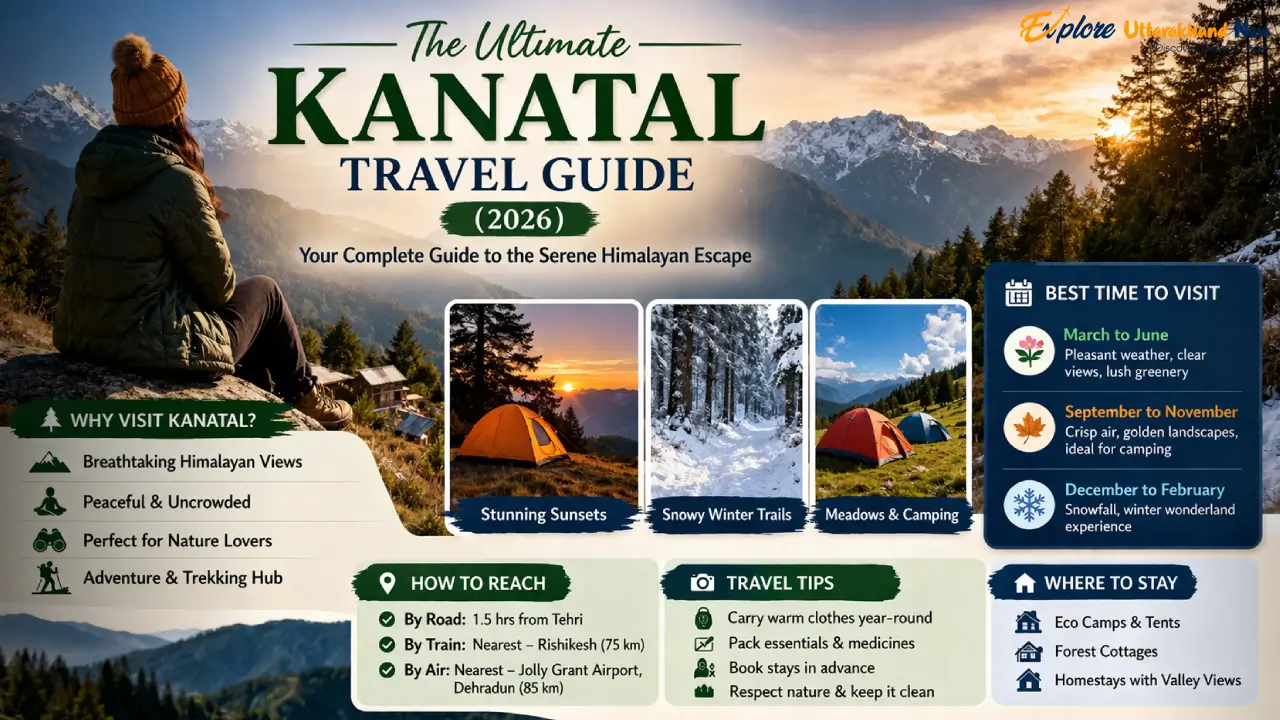
Kanatal sits 78 kilometres from Dehradun and 86 kilometres from Rishikesh. Both routes are excellent; they are simply different in character. The Dehradun route via Mussoorie–Kempty–Chamba is wider and faster (2.5–3 hours without traffic), but the Mussoorie section can be brutal on weekends. The Rishikesh–Chamba route is longer by 30 minutes but rewards you with the Rishikesh ghats at dawn, the quiet NH94 along the river, and a gentler climb through Chamba’s pine forests. We recommend the Rishikesh approach on the way up and the Dehradun route on the way down for maximum variety.
★ PRO TIP — DRIVING
Leave Delhi no later than 4:30 a.m. on a Friday or Saturday to clear the Haridwar/Rishikesh bottleneck before 9 a.m. The stretch from Chamba to Kanatal (14 km, last section) is narrow with steep drops — drive at 20–30 km/h and yield to oncoming vehicles. Snow chains are available for rent in Chamba from December through February.
Weather by Month: Why October Is the New “Peak Season”
| Month | Rating | Notes |
| Oct–Nov | ★★★★★ Peak | Crystal clear, fresh snow on peaks, best visibility, 5°C–18°C |
| Mar–Apr | ★★★★ Blossom | Rhododendrons in bloom, light crowds, pleasant temperatures |
| May–Jun | ★★★★ Pre-Monsoon | Milky Way season begins, warm days, check rain forecasts for June |
| Dec–Feb | ★★★ Snow | Snow possible on ridge, 4×4 recommended, magical if roads are clear |
| Jul–Aug | ★★ Monsoon | Moody and lush but persistent rain limits trekking and photography |
| Sep | ★★★ Shoulder | Rains tapering, trails muddy, good value accommodation |
Local Flavours: Beyond Maggi — Garhwali Food That Will Rewire Your Palate
| Gahat ki Dal Horsegram lentils slow-cooked with Pahadi ghee and dried red chillies. Earthy, nutty, deeply warming — the altitude equivalent of a blanket. Ask for it with thick bhaat (steamed rice) the way locals eat it. | Chainsoo Black gram (urad) roasted and then cooked into a thick, almost smoky dal with cumin and local masala. The roasting step gives it a depth utterly unique to the Garhwal hills. Found in few restaurants — ask home-stay hosts to make it. |
| Kafuli Green leafy vegetables — spinach, fenugreek, stinging nettle — slow-cooked in rice flour gravy. The aroma is herbal and faintly sweet; the taste is complex in a way that is difficult to articulate. We have eaten it at 7,500 feet on a cold morning and felt it warm us from the inside out. | Baal Mithai The sweet you will find wrapped in newspaper at every roadside stall from Rishikesh to Tehri — a dense chocolate-coloured fudge of roasted khoya coated in white sugar balls. Addictive. Carry some home. |
— FAQ —
Frequently Asked Questions (2026 Edition)
Is Kanatal safe for solo female travellers in 2026?
By the consistent account of solo female travellers we have spoken with, Kanatal is among the safest Himalayan destinations in North India. The community is small, the local population is accustomed to tourists, and most eco-lodge and homestay hosts are deeply invested in their guests’ safety. That said, universal precautions apply: inform someone of your itinerary before solo treks, carry a local SIM for emergency calls, and stick to marked trails after sunset. The Thuner trek is best not done solo — a local guide is recommended regardless of gender.
Can I find high-speed Wi-Fi for Zoom calls?
Yes — with selectivity. Most established lodges on the main Kanatal ridge now offer 40–100 Mbps Wi-Fi via fibre connections that came online in 2024–2025. However, verify with your specific property before booking if remote work is essential. Look for properties explicitly marketing workation packages; they have invested in the infrastructure. Budget homestays may still rely on mobile data via JioFiber dongles, which are adequate but can fluctuate.
Do I need a 4×4 vehicle for winter snowfall?
After moderate snowfall (typically January–February), the last 4 kilometres from Chamba to Kanatal can become challenging for standard 2WD vehicles. A 4×4 with snow chains is strongly recommended if you are visiting between December 15 and February 15. Post-snowfall road clearing by the PWD is usually completed within 12–24 hours for the main road. Many visitors park in Chamba and take a taxi or shared jeep for the final stretch in peak winter.
— FINAL WORD —
Conclusion: Making Memories, Not Just Footprints
Here is the truth about Kanatal in 2026: it is at an inflection point. The infrastructure has improved — the roads are better, the Wi-Fi is real, the EV chargers exist — but the soul of the place has not yet been processed. The deodar forests still creak in the wind. The gahat dal still tastes like someone’s grandmother cooked it. The Milky Way still appears above Jwarna like a private letter from the universe.
What keeps Kanatal unspoiled is not luck or geographical isolation — it is the deliberate, active choices of travellers. When you choose a ten-room eco-lodge over a large concrete resort, you are voting with your wallet for a certain kind of Himalayas. When you carry your trail waste out instead of leaving it, you are protecting a watershed that millions depend on downstream. When you buy a shawl from the women’s cooperative instead of a synthetic replica at a tourist stall, you are sustaining a craft that is otherwise one generation from extinction.
We travel to places like Kanatal because the world still has corners where you can hear yourself think. The best thing we can do for those corners is to leave them as we found them — or a little better.
Now It’s Your Turn
Have you been to Kanatal? Do you have a secret sunset point, a local food discovery, or a Himalayan dark-sky spot we haven’t written about? Drop it in the comments below — let’s build the most honest, community-powered travel guide on the internet, one Himalayan memory at a time.