The Confluence That Guards the Way to the Gods
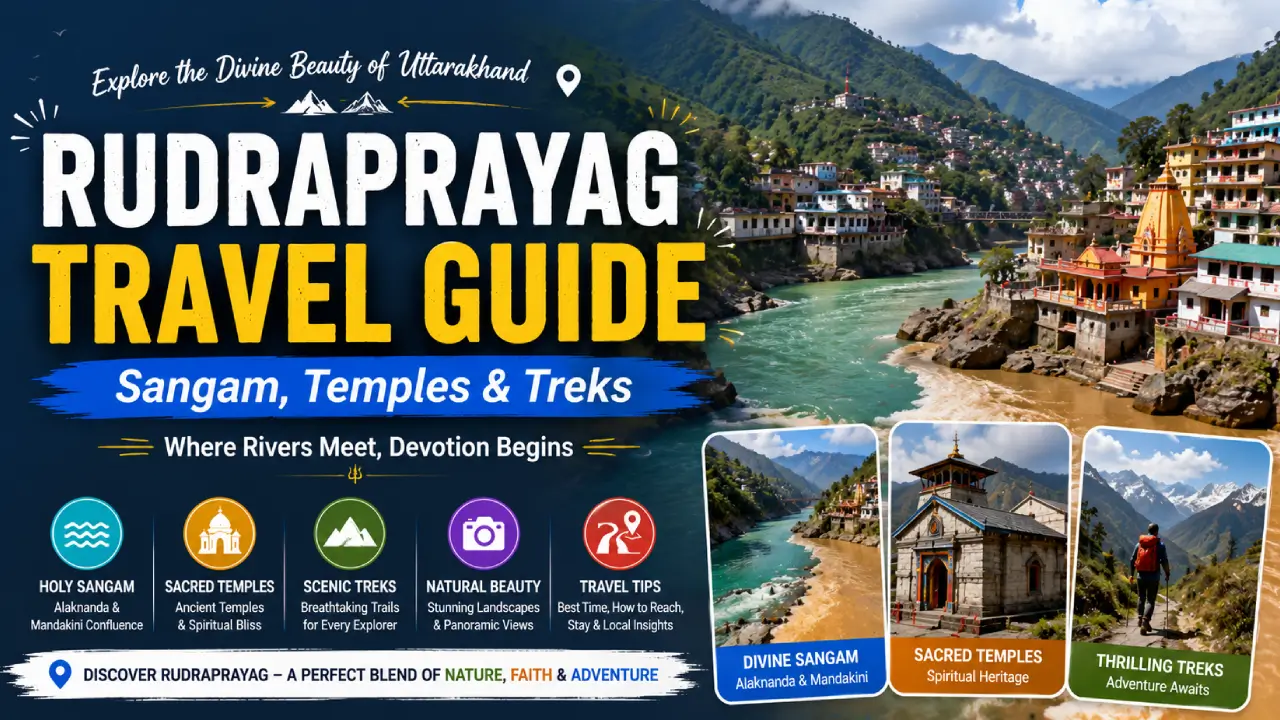
There’s a moment, if you’re driving up the Alaknanda valley toward the high Himalayas, when two rivers meet in a swirl of green and grey beneath a small temple town — and something in the landscape shifts. This is Rudraprayag, one of Garhwal’s sacred Panch Prayags, where the Alaknanda and Mandakini rivers merge in a confluence believed to be blessed by Lord Shiva himself.
But Rudraprayag is far more than a scenic river junction. It is, quite literally, the district you must pass through to reach some of Uttarakhand’s most revered destinations — Kedarnath Dham, the meadows of Chopta, and the ancient shrine of Tungnath all lie within its boundaries. Most travelers rush through on their way to somewhere else. This Rudraprayag travel guide makes the case for slowing down — because this district rewards those who treat it as a destination, not just a highway.
The Sacred Confluence & Local Attractions
Rudraprayag Sangam: Where Two Rivers Become One
The Rudraprayag sangam is the spiritual and geographic heart of the town. Here, the Alaknanda — flowing down from Badrinath — meets the Mandakini, which carries with it the sacred waters that have passed by Kedarnath. According to legend, it was at this very confluence that Narada Muni performed penance and was granted a vision of Lord Shiva in his fierce Rudra form, giving the town its name.
Standing at the ghats during early morning or dusk, as temple bells echo off the hillsides and the two rivers churn together in visibly different shades of water, is one of those quietly powerful experiences that photographs never quite capture. It’s worth spending a slow hour here before continuing your journey.
Koteshwar Mahadev Temple: A Cave Shrine on the Riverbank
Just a few kilometers from the main town, carved directly into the rock face on the banks of the Alaknanda, sits the ancient Koteshwar Mahadev temple. Legend holds that Lord Shiva meditated here after the events at Kedarnath, and the temple’s cave-like sanctum — cool, dim, and echoing with the sound of the river outside — has a raw, unpolished spirituality that larger temples often lose.
Getting there involves a short walk down stone steps to the riverbank, making it an easy, atmospheric stop for pilgrims and photographers alike. The interplay of natural rock formations, flowing water, and centuries of devotion makes this one of the more underrated places to visit in Rudraprayag.
Dhari Devi Temple: Guardian of Uttarakhand
A short drive from Rudraprayag town, on the banks of the Alaknanda, stands the Dhari Devi Temple — considered by many locals to be the guardian deity protecting the entire state. The temple holds a unique and much-discussed local belief: that the deity’s form changes throughout the day, appearing as a young girl in the morning, a woman by afternoon, and an elderly figure by evening.
The temple’s relocation during the Alaknanda hydroelectric project remains a topic of local conversation, adding a layer of contemporary history to its ancient spiritual significance. For travelers moving along the Badrinath highway, it’s a natural and meaningful stop.
The Gateway to Adventure and Faith
Kedarnath Dham Valley: Rudraprayag’s Crown Responsibility
Perhaps nothing defines Rudraprayag district more than its role as the base and gateway for Kedarnath Dham, one of the twelve Jyotirlingas and among the holiest sites in Hinduism. The trek to the shrine begins at Gaurikund, itself accessed via the district’s winding mountain roads, and the entire route — from the roadside dhabas to the mule stations — runs through Rudraprayag’s territory.
The valley leading up to Kedarnath is dramatic in its own right: glacial rivers, high-altitude meadows, and peaks that seem to grow taller with every switchback. If you’re planning the pilgrimage, it’s worth reading up in detail beforehand — our complete guide to Kedarnath’s history, legends, and travel tips covers everything from the temple’s mythology to practical trekking advice for the yatra.
Chopta, Tungnath & Chandrashila: The Mini Switzerland of India
Further into the district lies one of Uttarakhand’s most photogenic regions — Chopta, often nicknamed the “Mini Switzerland of India” for its rolling meadows, dense rhododendron forests, and panoramic Himalayan backdrops. From Chopta, a moderate trek leads to Tungnath, the highest Shiva temple in the world and one of the sacred Panch Kedar shrines, before continuing to the summit of Chandrashila, where a 360-degree view of peaks like Nanda Devi, Chaukhamba, and Trishul awaits on a clear day.
This trek has become a favorite for both first-time trekkers and seasoned photographers chasing golden-hour light on snow-capped ranges. For a full breakdown of the route, difficulty level, and best season to attempt it, our Chopta-Tungnath-Chandrashila trek guide is an essential read before you set out.
The Other Panch Kedar Shrines
Rudraprayag’s religious geography extends beyond Kedarnath and Tungnath. The district is also home to routes leading toward Madmaheshwar and Kalpeshwar, two of the remaining Panch Kedar temples. Madmaheshwar, reached via a scenic trek from Ransi village, sits in a remote, less-crowded valley, while Kalpeshwar — accessible with a relatively easy walk from Urgam village — is unique for being open to pilgrims year-round, unlike its high-altitude counterparts. Together, these shrines make Rudraprayag one of the most spiritually dense districts in all of Uttarakhand.
Practical Travel Information
Best Time to Visit Rudraprayag
- May to June: Peak pilgrimage and trekking season, with pleasant daytime temperatures and clear mountain views — ideal for both the Kedarnath yatra and the Chopta-Tungnath trek.
- September to November: The second major window, offering crisp air, minimal rainfall, and stunning post-monsoon clarity — widely considered the best time to visit Rudraprayag for photography.
- Monsoon (July–August): Exercise caution. Heavy rainfall increases the risk of landslides along NH 58 and the Kedarnath trekking route; many pilgrims and trekkers choose to avoid this window entirely.
- Winter (December–April): Kedarnath and Tungnath remain closed or largely inaccessible due to snow, though lower-altitude spots like the Sangam and Koteshwar Mahadev remain open year-round.
How to Reach Rudraprayag
- By Air: The nearest airport is Jolly Grant Airport, Dehradun, roughly 160 km away, with taxis and shared cabs available for the onward mountain journey.
- By Rail: The nearest well-connected railway stations are Rishikesh and Yog Nagari Rishikesh, both linked to major Indian cities, followed by a scenic 4–5 hour drive along the river valley.
- By Road: Rudraprayag sits directly on NH 58, the main highway connecting Rishikesh to Badrinath, making it easily accessible by private car, bus, or shared taxi from Dehradun, Haridwar, and Rishikesh.
Accommodation & Food
- GMVN Guesthouses: Government-run Garhwal Mandal Vikas Nigam properties offer reliable, budget-friendly lodging in Rudraprayag town and along the route to Kedarnath.
- Homestays: Villages like Ukhimath and Chopta offer authentic homestay experiences, often the best way to connect with local Garhwali life.
- Hotels & Lodges: A range of mid-range hotels line the highway through Rudraprayag town, catering primarily to pilgrims and trekkers passing through.
- Local Cuisine: Don’t miss trying traditional Garhwali dishes such as Chainsoo (roasted black gram dal) and Kafuli (a spinach and fenugreek curry), often served in small local eateries alongside simple dal-rice-roti thalis.
Conclusion: More Than a Passageway
It’s easy to see Rudraprayag purely as a stopover — a place you pass through on the way to Kedarnath or Chopta. But spend even half a day here, at the sangam, inside the cave sanctum of Koteshwar Mahadev, or in quiet conversation with a homestay host in Ukhimath, and you’ll understand that this district has its own gravity. It is where two sacred rivers become one, where legends of Shiva are woven into the very rock, and where the road to the divine truly begins.
Planning a trip through Rudraprayag? Share your travel dates or drop your questions in the comments below — we’re happy to help you plan a route that does this incredible district justice.