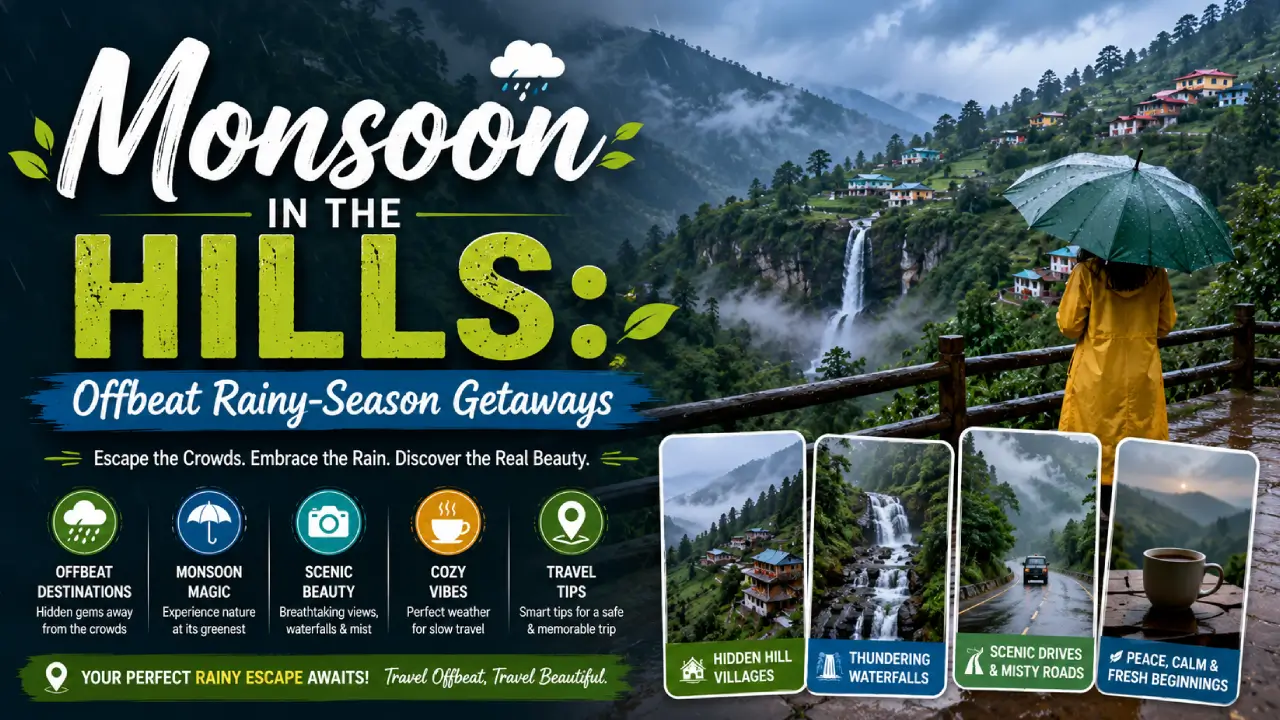
The Sound of Rain on Tin Roofs There’s a smell that arrives just before the first monsoon shower hits dry mountain earth — petrichor, the mountains call it their own kind of perfume. Clouds don’t stay in the sky here; they roll down through pine forests and settle into valleys, turning familiar roads into something dreamlike. Waterfalls that were shy trickles in April become thunderous, and every leaf seems to have been repainted in a deeper, wetter green. Most travelers avoid the hills during monsoon. Slippery roads, unpredictable weather, the risk of landslides — the hesitation is understandable. But here’s the secret that slow travelers and photographers have known for years: monsoon in the hills is, quietly, one of the best times to travel. The crowds evaporate, prices drop, and the landscape reveals a version of itself that summer tourists never get to see. If you’re willing to travel a little smarter, the rain rewards you generously. This guide is for the city dwellers craving mist through pine trees, the peace-seekers who want a hillside cafe to themselves, and anyone ready to trade a predictable summer vacation for something rawer and more atmospheric. Why Choose Offbeat Hill Stations in Monsoon? The appeal of offbeat monsoon destinations comes down to three things most travelers don’t expect until they experience it firsthand. Fewer crowds, more space to breathe. The hill stations that overflow with tourists in May and June go remarkably quiet in July and August. You can walk into a cafe without a wait, find a homestay without booking three months in advance, and actually hear the rain instead of a parking lot full of honking cars. Better prices, better value. Off-season rates apply almost everywhere — accommodation, local transport, even guided experiences often come at a noticeable discount, making monsoon travel considerably kinder on the wallet. Landscapes you simply can’t see any other time of year. Monsoon transforms mountain regions completely. Streams swell into waterfalls, terraced hillsides turn an almost electric green, and low-hanging clouds create a sense of scale and drama that dry-season photography rarely captures. For a sense of just how dramatic this transformation can be, it’s worth exploring the full extent of the monsoon magic in Uttarakhand, where entire valleys shift character with the season’s first heavy rains. Curated Offbeat Monsoon Getaways Landour or Kanatal, Uttarakhand: Quiet Above the Clouds Just above the bustle of Mussoorie sits Landour, a former cantonment town where mist-covered walking paths, old stone cottages, and secondhand bookshops replace the commercial chaos below. During monsoon, Landour’s narrow lanes disappear into fog by late afternoon, and its handful of cozy cafes become the perfect spot to watch rain streak down window panes with a hot cup of ginger tea in hand. For something even quieter, Kanatal — a small hamlet further along the ridge — offers pine-forest walks and misty hills with barely a tourist in sight. Both destinations trade Mussoorie’s crowds for a genuinely contemplative monsoon experience. Shoja or Jibhi, Himachal Pradesh: Wooden Cottages and Waterfalls Tucked into Himachal’s Tirthan Valley, Shoja and Jibhi have become quiet favorites among travelers seeking rustic charm over resort luxury. Wooden cottages perched on hillsides overlook apple orchards heavy with monsoon rain, and short walks lead to waterfalls that roar to life this time of year. The valley’s slower pace and riverside trails make it ideal for travelers who want their rainy-season escape to feel unhurried and lived-in rather than ticked off a checklist. Coorg or Wayanad, Western Ghats: Coffee, Downpours, and Endless Green Down south, the Western Ghats offer an entirely different monsoon character. In Coorg, coffee plantation stays let you fall asleep to the sound of heavy rain on estate rooftops, waking up to mist rolling over rows of coffee shrubs. In Wayanad, dense forest trails and stream crossings turn every walk into a small adventure, with waterfalls at near-peak flow and the air thick with the smell of wet earth and cardamom. If the Himalayas represent misty solitude, the Western Ghats during monsoon are lush, dramatic, and almost tropical in their intensity. Adventure in the Rain: Trekking Green Landscapes Not every monsoon traveler wants to sit still with a cup of tea — some want to move. For those chasing motion rather than stillness, monsoon transforms high-altitude meadows and valley trails into something genuinely spectacular. Wildflowers bloom across alpine meadows, rivers run high and vivid, and forest trails turn a saturated, almost unreal green. That said, monsoon trekking demands real caution and route knowledge — this isn’t the season for improvising a trail. If you’re an adventure enthusiast looking to combine movement with monsoon magic, it’s worth studying dedicated monsoon treks in Uttarakhand that cover which trails remain genuinely safe during the rains, along with the specific precautions each route demands. Going in informed is the difference between an unforgettable hike and an avoidable emergency. Essential Monsoon Survival & Packing Guide Chasing rain-washed valleys and misty hills is deeply rewarding — but only if you travel prepared. Keep this checklist close: Track conditions in real time — check landslide alerts and local weather warnings the morning of departure, not just the week before. Prioritize travel safety in rainy season by building buffer days into your itinerary for potential road blocks, delays, or sudden closures. Wear high-grip, waterproof footwear — monsoon trails are slick, and in forested regions, appropriate footwear also helps manage leeches. Protect your electronics — pack dry bags, ziplock pouches, and waterproof covers for cameras and phones; monsoon humidity and sudden downpours are unforgiving on gear. Avoid rigid, fully-booked itineraries — flexibility is your best asset when hill roads and weather don’t cooperate on schedule. Carry a basic first-aid and emergency kit, including a torch, power bank, and any personal medication, especially if heading into offbeat or low-connectivity areas. Conclusion: Let the Rain Lead the Way The hills in monsoon aren’t for everyone — and that’s exactly the point. For travelers willing to trade predictability for atmosphere, and a packed itinerary
Rudraprayag District Travel Guide
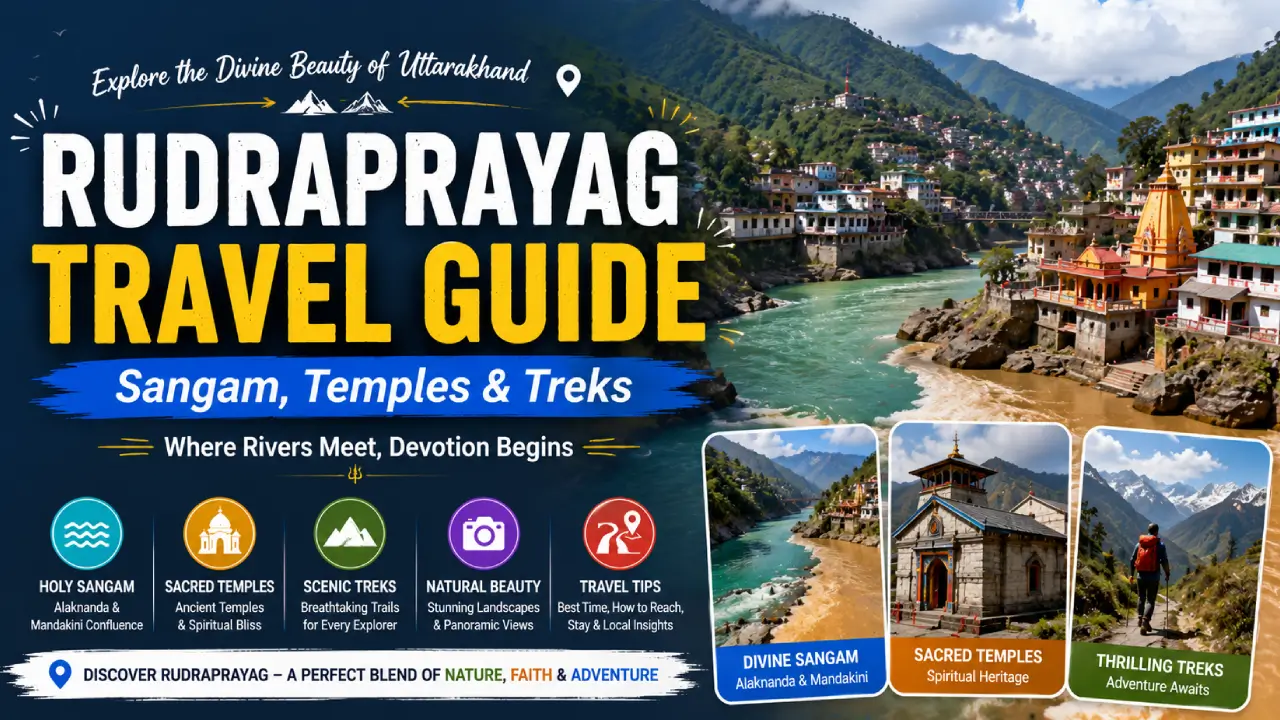
The Confluence That Guards the Way to the Gods There’s a moment, if you’re driving up the Alaknanda valley toward the high Himalayas, when two rivers meet in a swirl of green and grey beneath a small temple town — and something in the landscape shifts. This is Rudraprayag, one of Garhwal’s sacred Panch Prayags, where the Alaknanda and Mandakini rivers merge in a confluence believed to be blessed by Lord Shiva himself. But Rudraprayag is far more than a scenic river junction. It is, quite literally, the district you must pass through to reach some of Uttarakhand’s most revered destinations — Kedarnath Dham, the meadows of Chopta, and the ancient shrine of Tungnath all lie within its boundaries. Most travelers rush through on their way to somewhere else. This Rudraprayag travel guide makes the case for slowing down — because this district rewards those who treat it as a destination, not just a highway. The Sacred Confluence & Local Attractions Rudraprayag Sangam: Where Two Rivers Become One The Rudraprayag sangam is the spiritual and geographic heart of the town. Here, the Alaknanda — flowing down from Badrinath — meets the Mandakini, which carries with it the sacred waters that have passed by Kedarnath. According to legend, it was at this very confluence that Narada Muni performed penance and was granted a vision of Lord Shiva in his fierce Rudra form, giving the town its name. Standing at the ghats during early morning or dusk, as temple bells echo off the hillsides and the two rivers churn together in visibly different shades of water, is one of those quietly powerful experiences that photographs never quite capture. It’s worth spending a slow hour here before continuing your journey. Koteshwar Mahadev Temple: A Cave Shrine on the Riverbank Just a few kilometers from the main town, carved directly into the rock face on the banks of the Alaknanda, sits the ancient Koteshwar Mahadev temple. Legend holds that Lord Shiva meditated here after the events at Kedarnath, and the temple’s cave-like sanctum — cool, dim, and echoing with the sound of the river outside — has a raw, unpolished spirituality that larger temples often lose. Getting there involves a short walk down stone steps to the riverbank, making it an easy, atmospheric stop for pilgrims and photographers alike. The interplay of natural rock formations, flowing water, and centuries of devotion makes this one of the more underrated places to visit in Rudraprayag. Dhari Devi Temple: Guardian of Uttarakhand A short drive from Rudraprayag town, on the banks of the Alaknanda, stands the Dhari Devi Temple — considered by many locals to be the guardian deity protecting the entire state. The temple holds a unique and much-discussed local belief: that the deity’s form changes throughout the day, appearing as a young girl in the morning, a woman by afternoon, and an elderly figure by evening. The temple’s relocation during the Alaknanda hydroelectric project remains a topic of local conversation, adding a layer of contemporary history to its ancient spiritual significance. For travelers moving along the Badrinath highway, it’s a natural and meaningful stop. The Gateway to Adventure and Faith Kedarnath Dham Valley: Rudraprayag’s Crown Responsibility Perhaps nothing defines Rudraprayag district more than its role as the base and gateway for Kedarnath Dham, one of the twelve Jyotirlingas and among the holiest sites in Hinduism. The trek to the shrine begins at Gaurikund, itself accessed via the district’s winding mountain roads, and the entire route — from the roadside dhabas to the mule stations — runs through Rudraprayag’s territory. The valley leading up to Kedarnath is dramatic in its own right: glacial rivers, high-altitude meadows, and peaks that seem to grow taller with every switchback. If you’re planning the pilgrimage, it’s worth reading up in detail beforehand — our complete guide to Kedarnath’s history, legends, and travel tips covers everything from the temple’s mythology to practical trekking advice for the yatra. Chopta, Tungnath & Chandrashila: The Mini Switzerland of India Further into the district lies one of Uttarakhand’s most photogenic regions — Chopta, often nicknamed the “Mini Switzerland of India” for its rolling meadows, dense rhododendron forests, and panoramic Himalayan backdrops. From Chopta, a moderate trek leads to Tungnath, the highest Shiva temple in the world and one of the sacred Panch Kedar shrines, before continuing to the summit of Chandrashila, where a 360-degree view of peaks like Nanda Devi, Chaukhamba, and Trishul awaits on a clear day. This trek has become a favorite for both first-time trekkers and seasoned photographers chasing golden-hour light on snow-capped ranges. For a full breakdown of the route, difficulty level, and best season to attempt it, our Chopta-Tungnath-Chandrashila trek guide is an essential read before you set out. The Other Panch Kedar Shrines Rudraprayag’s religious geography extends beyond Kedarnath and Tungnath. The district is also home to routes leading toward Madmaheshwar and Kalpeshwar, two of the remaining Panch Kedar temples. Madmaheshwar, reached via a scenic trek from Ransi village, sits in a remote, less-crowded valley, while Kalpeshwar — accessible with a relatively easy walk from Urgam village — is unique for being open to pilgrims year-round, unlike its high-altitude counterparts. Together, these shrines make Rudraprayag one of the most spiritually dense districts in all of Uttarakhand. Practical Travel Information Best Time to Visit Rudraprayag May to June: Peak pilgrimage and trekking season, with pleasant daytime temperatures and clear mountain views — ideal for both the Kedarnath yatra and the Chopta-Tungnath trek. September to November: The second major window, offering crisp air, minimal rainfall, and stunning post-monsoon clarity — widely considered the best time to visit Rudraprayag for photography. Monsoon (July–August): Exercise caution. Heavy rainfall increases the risk of landslides along NH 58 and the Kedarnath trekking route; many pilgrims and trekkers choose to avoid this window entirely. Winter (December–April): Kedarnath and Tungnath remain closed or largely inaccessible due to snow, though lower-altitude spots like the Sangam and Koteshwar Mahadev remain open year-round. How to Reach Rudraprayag By Air:
Best Waterfalls in Uttarakhand: A Monsoon Guide
Where the Mountains Come Alive: The Magic of Monsoon in Uttarakhand There’s a particular kind of magic that happens in the Himalayan foothills once the monsoon clouds roll in. The dusty brown slopes of summer turn an impossible shade of green overnight. Streams that were barely a trickle in May swell into thundering cascades. The air smells like wet pine and earth, and every ridge disappears into a soft curtain of mist. This is monsoon in Uttarakhand — arguably the most dramatic, most photogenic, and most underrated season to visit the state. For backpackers, road-trippers, and weekend escapists from Delhi/NCR, monsoon season transforms Uttarakhand’s waterfalls into their most powerful, most spectacular versions of themselves. Rivers that trickle demurely in winter become roaring walls of white water. It’s the best time of year to chase falls — literally. But let’s be honest upfront: monsoon travel in the hills isn’t without risk. Landslides, slippery trails, swollen rivers, and sudden weather shifts are real hazards between June and September. This guide will take you through the best waterfalls in Uttarakhand to visit this monsoon — along with the safety tips for monsoon travel you genuinely need before you go. Top Waterfalls to Visit in Uttarakhand This Monsoon Tiger Falls, Chakrata: The Secluded Giant Tucked away near the sleepy cantonment town of Chakrata in Dehradun district, Tiger Falls is one of the tallest waterfalls in Uttarakhand, plunging roughly 312 feet down a sheer rock face into a natural pool below. What makes it special is how secluded it still feels — Chakrata has largely stayed off the mainstream tourist circuit, so you won’t be jostling for photo space here. How to reach: Drive to Chakrata (about 90 km from Dehradun), then continue toward Kanasar village. From the parking area, it’s roughly a 4–5 km trek down a forest trail to reach the falls. Why monsoon: The flow is at its most ferocious in July and August, and the surrounding deodar forest turns a lush, saturated green. Just note that the descent trail gets slick — this one demands sure footing. Kempty Falls & Bhatta Falls, Mussoorie: Crowd-Pleasers with Good Reason No list of Uttarakhand waterfalls is complete without Kempty Falls, Mussoorie’s most famous cascade. It’s touristy, yes — there are shops, changing rooms, and crowds — but the multi-tiered falls dropping from a height of nearly 40 meters are genuinely spectacular once the monsoon rains kick in. A short cable car ride or a walk down from the main road gets you right to the base. Just a few kilometers away, Bhatta Falls offers a quieter, more nature-immersed alternative, set inside a small valley with terraced pathways and less commercial hustle — better suited if you’re traveling with family and want a calmer experience. How to reach: Both falls are easily accessible from Mussoorie town, about a 5–6 hour drive from Delhi, making this a solid weekend-trip option. Why monsoon: Water volume multiplies dramatically, and the surrounding hillsides are draped in fog and greenery — though this is also when the falls get their strongest currents, so caution is key (more on that below). Corbett Falls, Ramnagar: A Peaceful Jungle Escape If you’re craving quiet over crowds, Corbett Falls, near Ramnagar, offers a completely different monsoon experience. Set inside a forested patch close to Jim Corbett National Park, this modest but beautiful waterfall requires a short, easy walk through dense sal forest to reach — the kind of walk where you’re more likely to hear birdsong than tourist chatter. How to reach: Located about 6 km from Ramnagar town, it’s an easy detour if you’re already headed toward Corbett for a jungle safari. Why monsoon: The forest is at its most alive, with the added bonus that this area combines beautifully with a broader Corbett trip — think jungle drives paired with a peaceful waterfall walk. Sahastradhara, Dehradun: The Thousand-Fold Spring Sahastradhara, meaning “thousand-fold spring,” is less a single waterfall and more a network of sulfur springs and small cascades set within limestone caves just outside Dehradun. Locals and visitors alike come here for the sulfur water, believed to have therapeutic properties for skin conditions — the mildly pungent smell is a small price to pay for a dip many swear by. How to reach: Just 14 km from Dehradun city center, making it an easy half-day trip, even for those short on time. Why monsoon: The springs and streams swell with the rains, and the surrounding limestone cave formations look their most dramatic against the wet, green backdrop. Vasudhara Falls, Badrinath: For the Serious Trekker For travelers chasing something more adventurous, Vasudhara Falls, near Badrinath, rewards the effort with one of the most awe-inspiring sights in the region — water cascading nearly 400 feet down a sheer cliff, framed by snow-dusted peaks. How to reach: From Badrinath, it’s roughly a 5–6 km trek (one way) via Mana village, India’s last village on the Indo-Tibet border. The trail is moderately challenging, involving boulder-strewn paths. A word of caution: This one deserves special mention — Vasudhara sits at high altitude and the trail can be genuinely risky during heavy monsoon spells, with rockfall and landslide potential along the Badrinath route. Always check current road and trail conditions before attempting this trek in July or August; many trekkers prefer this one just after peak monsoon, in early autumn. Offbeat & Hidden Waterfalls Worth Seeking Out If you’d rather skip the crowds entirely, Uttarakhand has plenty of hidden waterfalls that rarely make it onto mainstream itineraries. Patna Waterfall, Rishikesh: Tucked into the hills above Rishikesh, this lesser-known cascade requires a short trek through forest trails and rewards visitors with a private, untouched pool — ideal for travelers who’ve already ticked off Rishikesh’s more famous sights and want something quieter. Shikhar Falls, Dehradun: A relatively unknown gem near Dehradun, Shikhar Falls sees a fraction of the footfall of Sahastradhara despite being just as scenic. It’s a great option if you’re road-tripping through the Doon valley and want
The Ultimate Kanatal Travel Guide (2026)
India’s most quietly magical Himalayan escape, reimagined for the modern traveller Close your eyes and imagine this: you are sitting on a ridge at 8,200 feet, wrapped in a Garhwali shawl, watching the Milky Way arc across a sky so dark it feels personal. Below you, a sea of deodar pine rolls away into silence. No honking horns. No hawkers. Just the distant tinkle of a cowbell, and the hush of altitude. This is Kanatal — and in 2026, it is still, miraculously, all yours. We have been writing about offbeat Uttarakhand for years, and every time we think Kanatal is about to tip into the mainstream, it surprises us with another layer of quiet. This guide is the most comprehensive we have ever produced — built for the digital nomad who needs a solid Wi-Fi SLA, the adventure seeker who wants snow and adrenaline in the same weekend, the photographer hunting the Milky Way, and the conscious traveller who refuses to leave footprints. Welcome to the cloud forest. Let us go in. — THE DESTINATION — Why Kanatal in 2026? The Unspoiled Himalayan Escape The Shift from Mussoorie: Why Travellers Are Choosing Kanatal’s Silence Mussoorie had its glory days. Mall Road at 6 p.m. on a weekend in October now looks less like a hill-station promenade and more like a metro station at rush hour. The traffic queues on the Kempty Fall road stretch back kilometres. Hotels have multiplied like monsoon mushrooms. And so, quietly, a certain breed of traveller — tired, discerning, allergic to crowds — has been routing 38 kilometres further northeast into the Tehri Garhwal district, to a ridge-top village sitting at 8,500 feet where the air still bites and the horizon still belongs to Bandarpunch and Swargarohini. Kanatal is not a secret. But it is well-behaved. The Uttarakhand government’s eco-zoning restrictions have kept large hotel chains at bay. Most accommodations are small — ten rooms or fewer — and the road that winds up from Chamba is just sinuous enough to discourage casual day-trippers. The result is a place that feels, even in 2026, genuinely unhurried. When you wake up to the sound of nothing but wind through pine needles, you understand immediately why people who come once tend to come back obsessively. “The morning mist doesn’t lift in Kanatal — it performs. It rises slowly from the valley like a curtain, revealing the Himalayan panorama in acts.” What’s New: The Rise of Astro-Tourism and Eco-Glamping Two trends have quietly transformed the Kanatal experience in recent years and reached a tipping point by 2026. The first is astro-tourism — the act of travelling specifically to witness a dark sky. With Delhi’s night sky registered at a Bortle Class 9 (near-total light pollution), the drive of six hours to reach Kanatal’s Bortle Class 3–4 darkness is, for many urban Indians, nothing short of revelatory. Several properties now offer dedicated stargazing decks, red-light torch rentals, and in-house astronomers during peak season (May to September). The second is eco-glamping, which in Kanatal has evolved well beyond the canvas-tent-with-a-mattress phase. Think: precision-engineered geodesic domes with panoramic acrylic skylights, composting toilets, rainwater harvesting, and in-room wood-fired stoves. Several of these properties have received certification from the Uttarakhand Homestay & Eco-Tourism Board. Booking them months in advance for the October window is now simply non-negotiable. — BEFORE YOU GO — The 2026 Traveller’s Digital & Logistics Checklist Connectivity Check: 5G Availability (Jio/Airtel) and “Dead Zones” in Kodia Jungle The good news first: both Jio and Airtel have expanded 5G coverage along the Chamba–Kanatal main stretch, and most lodges on the primary ridge now report consistent 40–80 Mbps download speeds — more than sufficient for 4K video calls. Step off the main road into the Kodia Jungle trails, however, and you will hit near-complete dead zones within 400 metres. Download your maps and files before you lace up your boots. A local Jio SIM with a 5G pack remains the most reliable solution; Airtel works equally well on the ridge but can be spottier on the Tehri-facing slope. EDITOR’S NOTE Several eco-lodges now offer a dedicated “Work Pod” — a small insulated cabin with a wired ethernet connection and a ring-light, positioned for the best valley view. If remote work is your primary reason for visiting, ask your host about this specifically when booking. EV Charging Stations: Nearest Fast-Chargers There are no fast-chargers in Kanatal village itself as of early 2026. Your nearest options: Tehri Dam area (28 km): Two Tata Power EZ Charge DC fast-chargers (60 kW) at the THDC township. Reliable, 24-hour. Chamba town (14 km): A 22 kW AC charger at the petrol pump on the Rishikesh–Dharasu road. Slower, but convenient for overnight top-ups. Dehradun gateways: Multiple 120 kW+ fast-chargers at the ISBT area and Pacific Mall. Charge up fully before ascending. Rishikesh: Three fast-charger bays near the Triveni Ghat parking area. Ideal if you are coming via the scenic Rishikesh–Chamba route. Pro tip: If you are driving a long-range EV (400+ km range), a full charge from Dehradun will comfortably cover the Kanatal round trip. For shorter-range vehicles, plan a top-up at Chamba on arrival. Permits & Entry: Updated 2026 Guidelines Kanatal itself requires no permit for regular visitors. Two situations where documentation matters: if you are transiting on the Char Dham route during the April–June and September–October pilgrimage seasons, expect checkpoints at Chamba and Dharasu where your vehicle RC and ID are verified. Seasonal forest permits for Kodia Jungle (valid April–June and September–November) cost ₹100 per person and are now available online through the Uttarakhand forest department portal — do this in advance to skip the queue. Cash vs. Digital: Where UPI Works and Why You Need Emergency Cash On the main stretch and at established lodges, UPI (Google Pay, PhonePe, Paytm) works seamlessly. The situation changes once you head toward local hamlets — places like Kotigaon or the lanes of Jwarna village. Here, older shopkeepers and dairy farmers operate exclusively on cash. Carry at least
Pithoragarh Travel Guide Exploring the Little Kashmir of Uttarakhand in 2026
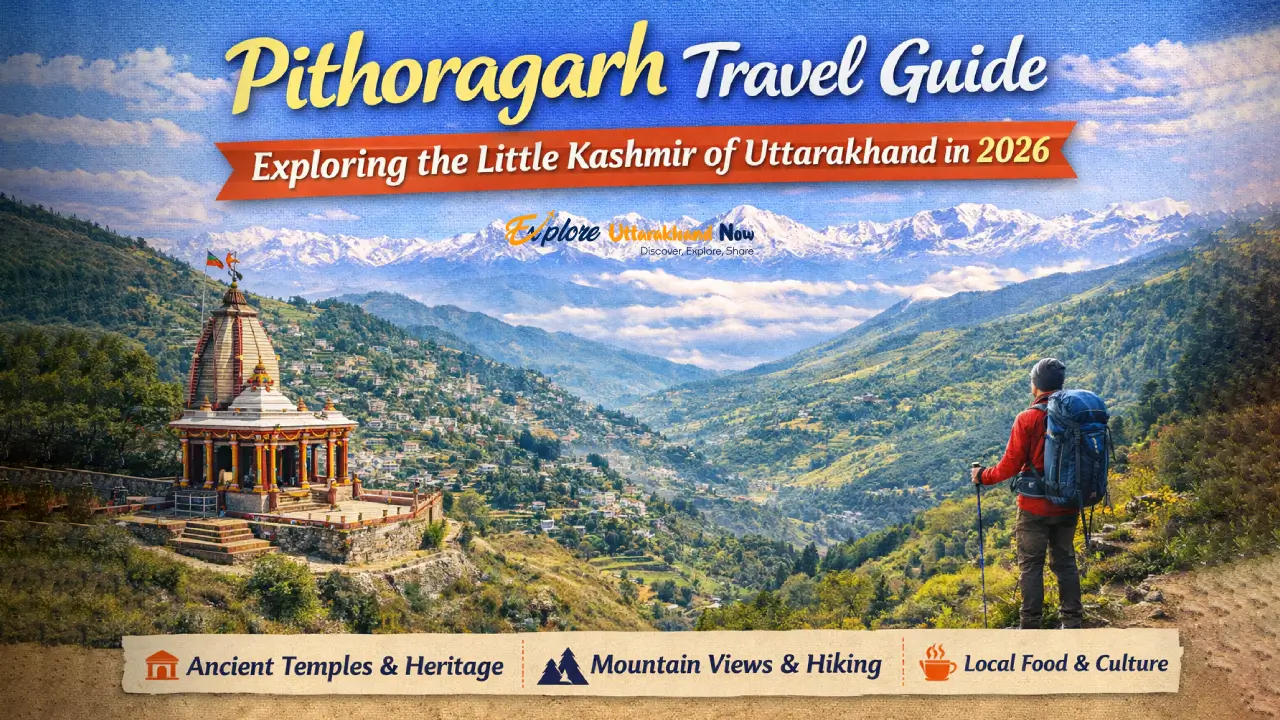
Quick Facts at a Glance 📌 Detail ℹ️ Info 🗓️ Best Time Altitude: 1,814 m District HQ, Kumaon March – June Nearest Railway: Tanakpur (~151 km) Airport: Naini Saini (5 km) Sept – November Distance from Delhi: ~480 km From Almora: ~116 km Avoid: July – August Pithoragarh: The Little Kashmir of the Himalayas There are places that earn their nicknames, and then there are places that deserve them. Pithoragarh — the district headquarters of Uttarakhand’s easternmost district, nestled at 1,814 metres in the Kumaon Himalaya — has been called “Little Kashmir” since travellers first arrived and fell silent at the view. The reason is immediately apparent to anyone who has seen the Soar Valley from the surrounding ridges: a wide, verdant basin cupped by forested hillsides and framed by the snow-mantled peaks of Nanda Devi, Panchachuli, and the Api-Nampa range on the Nepal border. The resemblance to the Dal Lake basin in Kashmir — that specific combination of flat valley floor, surrounding mountains, and luminous light — is not a tourist promotion’s conceit. It is genuinely, startlingly real. But Pithoragarh carries far more than a pretty comparison. It is one of Uttarakhand’s most historically layered towns — ruled by the Chand Kings, contested by the Gorkha empire, and shaped by British administration. It is the last major town before the Kailash Mansarovar Yatra route climbs into the high Himalayas toward Tibet — a fact that gives the town a particular spiritual gravity, as pilgrims and trekkers gather here year after year before journeys into some of the most sacred terrain on Earth. Pithoragarh also sits at the heart of a region rich in hidden places, ancient temples, trekking routes, and a distinctive Kumaoni cultural life that rewards slow, curious travel. Whether you arrive as a pilgrim, an adventurer, a history lover, or simply someone who wants to look at mountains, this Pithoragarh travel guide covers everything you need. For a broader Kumaon context, our ultimate guide to the best hill stations in the Kumaon region will help you build the perfect regional itinerary. Pithoragarh Travel News: 2026 Update Here is the latest Pithoragarh travel news and connectivity update for the 2026 travel season: 📰 PITHORAGARH TRAVEL NEWS — 2026 UPDATE Naini Saini Airport — Improved Connectivity (2026): Naini Saini Airport, just 5 km from town, has seen significant runway and terminal upgrades. As of 2026, improved services connect Pithoragarh with Dehradun and Delhi on select days, dramatically reducing travel time. Always confirm current schedules before travel, as mountain route services are subject to seasonal weather disruptions. Road Conditions (2026 Season): The primary road links via Almora (NH-309A) and via Tanakpur-Champawat have seen resurfacing and improved drainage. Check with local transport authorities before travel between July and September when monsoon rains can cause temporary closures. Kailash Mansarovar Yatra (2026): The Government of India has confirmed phased resumption of the Kailash Mansarovar Yatra via the Lipulekh Pass route for 2026, subject to bilateral arrangements with China. Intending pilgrims should register with the Ministry of External Affairs well in advance. Soar Valley Road Project: Road improvement works in the Soar Valley are ongoing; some detours may be in effect in early 2026. Confirm locally before planning day trips to Chandak or valley viewpoints. The History of Pithoragarh: Empires in the Mountains Pithoragarh’s history is as layered as the geology of the hills surrounding it. The town’s earliest traceable history connects it to the Chand dynasty of Kumaon — the medieval rulers who, from their seat at Champawat and later Almora, shaped the cultural, religious, and administrative landscape of the entire Kumaon region from the 10th to the 18th century. The Chand kings were prolific temple builders and art patrons. Several sacred sites that define Pithoragarh today — including the Mostamanu Temple and traditions surrounding Dhwaj Temple — trace their origins or patronage to the Chand period. In the late 18th century, the Gorkha empire — expanding aggressively from Nepal — absorbed Pithoragarh into its domain (1790–1815). The Gorkha period left distinct marks: the military fortifications later expanded by the British, the Nepali-inflected linguistic patterns still audible in parts of the district, and the cultural interchange that shaped local customs and craft traditions. The Gorkhas were expelled following the Anglo-Nepalese War (1814–16), after which Pithoragarh became part of British India. The colonial administration built the Pithoragarh Fort (London Fort), developed the cantonment, and established the administrative infrastructure that shaped the town’s modern form. Independence in 1947 transferred this legacy to the Indian state, and Pithoragarh today wears all three layers of its history simultaneously — Chand, Gorkha, and British — in its temples, fortifications, and cultural life. Places to See in Pithoragarh Pithoragarh Fort (London Fort) The most iconic structure in Pithoragarh, the Pithoragarh Fort — known locally as the London Fort — dominates the town from its hilltop position above the Soar Valley. Built during the Gorkha occupation and significantly extended by the British, the fort’s weathered stone walls and bastions are a potent symbol of the town’s contested, multilayered past. From the upper ramparts, the full sweep of the Soar Valley is visible — the flat, cultivated basin surrounded by forested ridges, with the distant white profiles of the high Himalaya framing the northern horizon. Best for: History enthusiasts, photography, panoramic Soar Valley views Distance: ~1.5 km from town centre; accessible by short uphill walk or vehicle Chandak Hills — Himalayan Panorama at 2,600 m About 7 km from Pithoragarh town, Chandak Hills rises to approximately 2,600 metres and offers what many consider the finest accessible viewpoint in the entire district. On a clear morning, the panorama encompasses the Panchachuli peaks, the Api-Nampa massif on the Nepal border, and on exceptional days, the white dome of Nanda Devi hovering above the horizon. A government-run guesthouse at the summit makes overnight stays possible, allowing you to catch both sunset and sunrise panoramas in a single visit. Distance: ~7 km; taxi or private vehicle recommended Stay: KMVN guesthouse at Chandak; advance
Almora Travel Guide Exploring the Cultural Heart of Kumaon in 2026
📋 Quick Facts at a Glance 📌 Detail ℹ️ Info Altitude 1,638 m (5,374 ft) Best Season March–June & Sept–Nov Distance from Delhi ~370 km (9–10 hrs by road) Nearest Railway Kathgodam (~90 km) Nearest Airport Pantnagar (~125 km) Ideal Duration 3–4 days 🏔️ Introduction: The Horseshoe Town That Stole the Hills There are hill stations, and then there is Almora — a place that feels less like a destination and more like a discovery. Draped across a crescent-shaped ridge at an altitude of 1,638 metres in the Kumaon Himalaya of Uttarakhand, Almora is famously known as the “horseshoe town” for the distinctive curved shape of its hilltop perch. From this commanding vantage, the town looks outward over a sweeping panorama of snow-draped peaks — Nanda Devi, Trishul, Panchachuli — their white crowns visible on clear mornings like a promise kept across centuries. But Almora is far more than its views. It is the undisputed cultural capital of the Kumaon region — a living repository of Kumaoni art, architecture, folklore, cuisine, and craft. The town was founded in 1563 by the Chand dynasty, who shaped much of the region’s identity, and it has drawn artists, writers, and philosophers ever since. Swami Vivekananda meditated here. Alfred Sorensen — the Danish philosopher known as “Sunyata” — lived here for decades. Timothy Leary famously called Kasar Devi, just outside the town, one of the world’s great energy centres. In 2026, Almora rewards travellers willing to look beyond the obvious. While it may not have the commercial machinery of Nainital or the adventure infrastructure of Rishikesh, it offers something rarer: authenticity. Stone-paved bazaars where craftsmen still practice Aipan folk art. Temples older than most European nations. Forest trails where the only sound is wind through the pines. And food — oh, the food. From the legendary Bal Mithai to the crisp singori wrapped in maalu leaves — Almora feeds the soul as much as the stomach. Whether you’re building your first Almora travel guide itinerary, planning a romantic escape with your partner, a family trip with children, or arriving solo with a backpack and an open calendar — this guide covers everything you need. And if you’re wondering how Almora compares to other beautiful towns in this part of the mountains, our ultimate guide to Kumaon hill stations will help you plan the perfect regional itinerary. 🗺️ Top 10 Places to Visit in Almora Here are the ten experiences that define a truly complete Almora journey — from ancient sacred sites to forested sanctuaries to sun-drenched viewpoints. #1 Kasar Devi Temple — Where the Earth Hums Perched on Kashyap Hill, about 8 km from Almora town, Kasar Devi Temple is dedicated to the goddess Kasar Devi and is one of the most spiritually and scientifically intriguing sites in the entire Himalayan belt. The temple itself is ancient — believed to be over 2,000 years old — but what draws people from across the globe goes beyond religion. Scientists and researchers have noted that Kasar Devi sits within a Van Allen Belt anomaly — a zone where the Earth’s magnetic field is unusually concentrated, similar to energy-dense sites like Machu Picchu in Peru and Stonehenge in England. This geological peculiarity is believed to contribute to the area’s extraordinary sense of calm, mental clarity, and heightened meditation. The forest around the temple has long attracted seekers and free spirits. From the 1960s onwards, it became a quiet gathering point for spiritual wanderers — earning the nickname “Hippie Hill” — and that gentle, contemplative energy has never really left. Today, meditation retreats and yoga centres dot the hillside. Best for: Meditation, sunrise visits, spiritual energy, solo travellers Distance from town: ~8 km; accessible by taxi or shared jeep ✅ Tip: Visit on weekdays for a quieter experience; the forest trail from the road to the temple takes about 10 minutes and is well-marked. #2 Jageshwar Dham — A Forest of 124 Ancient Temples About 35 km northeast of Almora, deep within a valley of towering ancient deodar cedars, lies Jageshwar Dham — one of the most extraordinary religious complexes in India. A cluster of 124 temples of varying sizes, built between the 7th and 12th centuries CE, are packed into a compact valley through which a cold stream trickles year-round. Dedicated primarily to Lord Shiva, the Jageshwar complex includes the Mrityunjaya Temple, the Dandeshwar Temple, and the Laghunath Temple among its most revered shrines. The Archaeological Survey of India maintains the site, and the atmosphere — ancient stone beneath a cathedral of cedars, with bells in the distance — is profoundly moving. Jageshwar is also a major pilgrimage destination during the Shravan month (July-August) when the Jageshwar Monsoon Festival draws thousands of Shiva devotees. Best for: History enthusiasts, pilgrims, architecture lovers, families Distance: ~35 km from Almora; roughly 1.5 hours by road through beautiful forested terrain #3 Chitai Golu Devta Temple — The Temple of Bells Drive 8 km east of Almora and you will hear it before you see it: a metallic symphony of thousands of bells, large and small, brass and copper, tied to every available surface — walls, gates, trees, railings. This is Chitai Golu Devta Temple, dedicated to Golu Devta, the most beloved and widely worshipped deity of the Kumaon region. Golu Devta — also called Goluwa — is considered the god of justice. Devotees come from across Uttarakhand to write petitions and letters to the deity on stamped paper or plain paper, pinning them to the walls alongside offerings of bells given in gratitude when prayers are answered. The entire temple complex is festooned with hundreds of thousands of these bells accumulated over generations. The temple has an extraordinary atmosphere — joyful, noisy, deeply human — that is unlike any other sacred site in the region. Best for: Cultural immersion, photography, all visitor types Tip: Bring a small bell as an offering — it’s a meaningful and inexpensive gesture #4 Katarmal Sun Temple — 9th-Century Solar Architecture A remarkable and criminally
The Ultimate Guide to Long Weekends in Uttarakhand
Best Places to Visit with Family and Friends in 2026 📍 Devbhoomi, Uttarakhand | ✈ Perfect for Delhi Escapes | 📅 Updated for 2026 INTRODUCTION Why Uttarakhand Is the Perfect 2026 Escape There’s a reason Uttarakhand is called Devbhoomi — the Land of Gods. Draped in Himalayan grandeur, whispering with the sound of sacred rivers, and dotted with colonial-era hill stations that smell of pine and rain-soaked earth, this one state offers something remarkable: it speaks differently to everyone who visits it. Planning long weekend getaways from Delhi in 2026? Uttarakhand is your answer — always. Whether you’re a family looking for safe, scenic, and memorable holidays with your children, or a group of friends chasing white water thrills, rooftop cafes with mountain views, and sunrise treks above the clouds — Uttarakhand delivers, every single time. Good Friday falls on April 3rd, giving you a 3-day weekend to escape the Delhi heat before summer truly bites. Then, in May, Buddha Purnima on May 12th creates another golden window for a mountain retreat. These are the windows you plan months in advance — and this guide will help you make every hour count. So pack your sunscreen, your sense of adventure, and your appetite for Maggi noodles on a misty hilltop. Let’s explore the best places to visit in Uttarakhand that are worth every kilometre of the drive. PLAN AHEAD The Long Weekend Calendar 2026 🗓 Mark these dates in your calendar right now — and start planning your Uttarakhand trip itinerary before the hotels fill up: Apr 3–5, 2026 Good Friday 3-Day Weekend · Spring bloom season May 12–14, 2026 Buddha Purnima 3-Day Weekend · Pre-monsoon clarity Aug 15–17, 2026 Independence Day 3-Day Weekend · Lush monsoon greens Pro Tip: For the Good Friday and Buddha Purnima weekends, book accommodations at least 6–8 weeks in advance. These are among the most sought-after long weekend getaways from Delhi, and properties at Mussoorie, Nainital, and Rishikesh fill up fast. TOP DESTINATIONS Top 5 Best Places to Visit in Uttarakhand These are not just popular — they are consistently extraordinary. Here are the five best places to visit in Uttarakhand for families and friends in 2026: 01 — Mussoorie & Landour Mussoorie & Landour: Colonial Charm & Café Culture The Queen of Hills needs no introduction, but Landour — its quieter, cooler twin — is where the real magic lives. Ruskin Bond’s Landour is a cobblestoned, bougainvillea-draped world apart from the Mall Road bustle, and it’s having a serious moment with India’s café culture crowd. For friends: Cafe Ivy, Sisters Bazaar, and Char Dukan for chai with Himalayan views For families: Gun Hill ropeway, Kempty Falls (book early!), and Lal Tibba viewpoint at sunset Don’t miss: The Landour Bakehouse for sourdough and filter coffee on a cold April morning Distance from Delhi: ~290 km · 6–7 hours by road Best for: Good Friday long weekend (April 3–5) 02 — Nainital & Bhimtal Nainital & Bhimtal: Lakes, Laughter & Family Resorts Nainital’s iconic lake shimmering under the Kumaon hills is the stuff of postcards. Pair it with the quieter Bhimtal, just 22 km away, where an island café sits right in the middle of the lake — calmer, less crowded, and more scenic. For families: Boating on Naini Lake, Snow View Point by ropeway, and the Nainital Zoo Bhimtal upgrade: Bhimtal Lake with its floating island café — far quieter than Nainital’s Mall Road Stay smart: Choose resorts in Bhimtal for quieter nights and better value Distance from Delhi: ~310 km · 6–7 hours via NH9 Best for: Buddha Purnima weekend (May 12–14) 03 — Rishikesh Rishikesh: Where Serenity Meets Adrenaline Rishikesh is the rare destination that works for every kind of traveller. Watch the Ganga Aarti at Triveni Ghat as diyas float downstream and the air fills with temple bells — one of the most genuinely moving experiences in India. Then, the very next morning, strap in for Grade III–IV white water rafting on the roaring Ganga. For families: Evening Ganga Aarti, Beatles Ashram (Chaurasi Kutia), and Ram Jhula walks at dusk For friends: White water rafting (16 km or 36 km stretches), bungee jumping at Jumpin Heights Stay: Glamping tents along the Ganga for the ultimate friends’ trip vibe Distance from Delhi: ~240 km · 5–6 hours Best for: Any long weekend — it’s an all-season destination 04 — Chopta (Mini Switzerland) Chopta: Uttarakhand’s Best-Kept Trekking Secret If your group of friends is done with the Instagram-famous spots, Chopta is the answer. Called the Mini Switzerland of India, this meadow-draped hamlet at 2,680 metres sits at the base of the famous Tungnath trek — the highest Shiva temple in the world at 3,680 metres. The trek: Chopta to Tungnath is a 3.5 km ascent (moderate difficulty) — doable in a long weekend Chandrashila summit: Add another 1.5 km for 360-degree Himalayan panoramas including Nanda Devi Best time: April–June (post-snow) and October–November — avoid monsoon for safety Stay: Basic campsites and forest rest houses — budget-friendly and high on adventure Distance from Delhi: ~450 km · 10–11 hours (plan an overnight halt at Ukhimath) 05 — Jim Corbett National Park Jim Corbett: India’s Premier Wildlife Experience India’s oldest national park and the flagship of Project Tiger — Jim Corbett is the wildlife safari experience your family will talk about for years. With the highest density of Bengal tigers in India, a sunrise jeep safari through the Dhikala or Bijrani zones is simply electric. For families: Jeep safaris in the Jhirna and Dhela zones — excellent tiger sighting records Wildlife beyond tigers: Asian elephants, leopards, gharials, over 600 bird species Stay: Riverside eco-lodges in Corbett — book Dhikala Forest Rest House for the ultimate experience Book early: Safari permits open 45 days in advance and sell out rapidly for long weekends Distance from Delhi: ~245 km · 5 hours via NH9 HIDDEN GEMS Offbeat Uttarakhand: For Those Who Hate the Crowds Long weekends mean crowded highways and overbooked hotels
Padma Awardees from Uttarakhand – Complete List & Inspiring Stories
Uttarakhand Pride and Honor Uttarakhand, often hailed as the “Land of the Gods” due to its vast spiritual heritage and breathtaking Himalayan landscapes, is also a cradle of remarkable human achievement. Beyond its natural beauty, this northern Indian state has nurtured and produced individuals whose extraordinary contributions across diverse fields have earned them national and international acclaim. One of the most prestigious ways India honors such exceptional citizens is through the Padma Awards—Padma Vibhushan, Padma Bhushan, and Padma Shri—which recognize distinguished service and achievements in various disciplines including arts, literature, social work, environment, medicine, sports, education, and public service. The story of the Padma Awardees from Uttarakhand is a powerful testament to the state’s rich cultural fabric and the resilient spirit of its people. Despite geographical challenges posed by its mountainous terrain, many individuals have risen to national prominence through sheer dedication, vision, and perseverance. Their contributions have not only brought pride to Uttarakhand but have also significantly influenced India’s social, cultural, scientific, and environmental landscape. The Padma Awards, instituted by the Government of India in 1954, are among the highest civilian honors in the country. The Padma Vibhushan is the second-highest civilian award, followed by the Padma Bhushan and the Padma Shri. Uttarakhand’s distinguished citizens who have received these awards represent a broad spectrum of fields and endeavors. From the brave military leadership of General Bipin Rawat to the environmental activism of Shri Sunderlal Bahuguna and Shri Chandi Prasad Bhatt, from the literary brilliance of Ruskin Bond to the pioneering social work of Kunwar Singh Negi, Uttarakhand pride personalities have left indelible marks in their respective domains. These awards celebrate not only individual excellence but also the cultural richness and social responsibility that define Uttarakhand’s identity. The recipients often embody values deeply rooted in the region—respect for nature, commitment to social welfare, passion for preserving cultural heritage, and striving for innovation in science and technology. About Padma Awards in India History and Significance The Padma Awards were instituted in 1954 by the Government of India to recognize exceptional and distinguished service in any discipline. These awards stand second only to the Bharat Ratna in terms of precedence and are announced annually on the occasion of Republic Day. The awards recognize work of “high level” and “special impact” across various fields including art, social work, public affairs, science, engineering, trade, literature, education, sports, medicine, and more. For a state like Uttarakhand, these awards highlight the rich cultural and social capital that the region contributes to the nation. Categories: Padma Vibhushan, Padma Bhushan & Padma Shri Padma Vibhushan: Awarded for “exceptional and distinguished service.” It is the highest category of the Padma awards and the second-highest civilian honor in India. Padma Bhushan: Awarded for “distinguished service of a high order” – the third-highest civilian award. Padma Shri: Awarded for “distinguished service” – the fourth-highest civilian award. This is the most common award given to ground-level heroes, artists, and social workers. While Uttarakhand has a rich history of producing exceptional individuals, most of its recognized Padma Awardees from Uttarakhand have been conferred the Padma Shri and Padma Bhushan, acknowledging their profound impact at both grassroots and national levels. Complete List of Padma Awardees from Uttarakhand (Year-Wise) To understand the legacy of Uttarakhand pride personalities, let us look at the comprehensive list of award winners who hail from the state or have done significant work there. Based on official records and historical data, here is the complete list of distinguished awardees. No. Name Field / Contribution Year Award Category 1 Shri Hugh and Colleen Gantzer (Posthumous) (Duo) Missionaries, social workers 2025 Padma Shri 2 Smt. Radha Bahin Bhatt Social work 2025 Padma Shri 3 Dr. Yashwant Singh Kathoch Medical profession 2024 Padma Shri 4 Dr. Madhuri Barthwal Folk singer, music educator 2022 Padma Shri 5 Smt. Basanti Devi Environmentalist 2022 Padma Shri 6 Ms. Vandana Kataria International hockey player 2022 Padma Shri 7 Dr. Bhupendra Kumar Singh Sanjay Orthopedic surgeon 2021 Padma Shri 8 Shri Prem Chand Sharma Progressive farmer 2021 Padma Shri 9 Dr. Anil Prakash Joshi Environment – Founder of HESCO 2020 Padma Bhushan 10 Dr. Yogi Aeron Medical professional, free healthcare 2020 Padma Shri 11 Shri Kalyan Singh Rawat Educator, social worker 2020 Padma Shri 12 Ms. Bachendri Pal Sports – First Indian woman to summit Everest 2019 Padma Bhushan 13 Shri Pritam Bhartwan Folk artist, traditional singer 2019 Padma Shri 14 Shri Anup Sah Social worker 2019 Padma Shri 15 Dr. Vikram Chandra Thakur Environmental science researcher 2018 Padma Shri 16 Smt. Basanti Bisht Folk singer 2017 Padma Shri 17 Swami Dayananda Saraswati (Posthumous) Spiritual Leader – Advaita Vedanta 2016 Padma Bhushan 18 Shri Swami Satyamitranand Giri Religion / Social Work 2015 Padma Bhushan 19 Shri Ruskin Bond Literature – English Writer 2014 Padma Bhushan 20 Shri Irwin Allan Sealy Author, novelist 2012 Padma Shri 21 Prof. D. D. Sharma Scholar, academician 2011 Padma Shri 22 Dr. Ranjit Bhargava Environmentalist 2010 Padma Shri 23 Shri Sunderlal Bahuguna Environment – Chipko Movement Leader 2009 Padma Vibhushan 24 Dr. Rakesh Kumar Jain Medical researcher 2008 Padma Shri 25 Dr. Lalit Pande Educationist, social worker 2007 Padma Shri 26 Prof. Devindra Rahinwal (Posthumous) Historian, writer 2007 Padma Shri 27 Prof. (Dr.) Shekhar Pathak Historian, author 2007 Padma Shri 28 Shri Khalid Zaheer Artist, cultural promoter 2007 Padma Shri 29 Dr. Anil Prakash Joshi Environmentalist, HESCO founder 2006 Padma Shri 30 Dr. Yashodhar Mathpal Archaeologist, rock art specialist 2006 Padma Shri 31 Shri Chandi Prasad Bhatt Environmental Activism – Chipko Movement 2005 Padma Bhushan 32 Shri Leeladhar Jagoodi Poet, writer 2004 Padma Shri 33 Shri Kanhaya Lal Pokhriyal Scholar, literary figure 2003 Padma Shri 34 Dr. Anand Swarup Arya Social worker, educationist 2002 Padma Shri 35 Shri Bhairab Dutt Pande Civil Service, Governance 2000 Padma Vibhushan 36 Shri Ruskin Bond Author, writer 1999 Padma Shri 37 Vaidya Balendu Prakash Ayurveda practitioner 1999 Padma Shri 38 Prof. Aditya Narain Purohit Botanist, environmental scientist 1998 Padma Shri 39 Shri Madhava Ashish Social worker, sustainable
Your Complete Guide to the Chenap Valley Trek
Oh, friends, let me take you back to that moment when I first stepped into the Chenap Valley. The air was crisp and alive with the whisper of the wind rustling through endless meadows dotted with wildflowers in every color imaginable—vibrant blues, sunny yellows, and delicate pinks swaying like they were dancing just for me. In the distance, a river gurgled softly over smooth stones, its melody blending with the occasional call of a mountain bird. And towering above it all, those majestic snow-clad peaks of the Himalayas stood like ancient guardians, their white caps glowing in the sunlight. It felt like I’d wandered into a secret world, untouched and pure, where time slows down and your worries just melt away. If you’ve ever dreamed of a trek that feels like discovering a hidden gem in the Himalayas, the Chenap Valley—sometimes called Chanap Valley by locals—is that place. Tucked away in the Chamoli district of Uttarakhand, this valley is a secret sanctuary bursting with alpine meadows, crystal-clear lakes, and breathtaking views of giants like Nanda Devi and Trishul. What makes the Chenap Valley Trek so special? It’s not overcrowded like some famous trails; it’s got that raw, intimate connection to nature that leaves you feeling renewed. And the best part? It’s accessible enough for aspiring trekkers but rewarding for seasoned adventurers. In this guide, I’m sharing everything I learned from my own journey there—the practical details, the thrills, the challenges, and the pure joy—so you can plan your own unforgettable trip with confidence. Whether you’re a nature lover craving serene landscapes or an adventure seeker ready for a moderate challenge, this trek will steal your heart. Unveiling the Chenap Valley Trek Picture this: you’re weaving through lush forests of oak and rhododendron, the scent of pine filling your lungs, and suddenly the trail opens up to sweeping vistas of bugyals—those high-altitude meadows that look like nature’s own carpet. The allure of the Chanap Valley Trek lies in its untouched beauty; it’s like the Valley of Flowers’ quieter sibling, with fewer crowds and just as much magic. Located in the Garhwal Himalayas, it’s a paradise for anyone who wants to immerse themselves in alpine flora, spot rare orchids and primulas blooming in summer, and gaze at snow peaks that seem close enough to touch. One of the things I love most is how doable it is from Delhi—it’s not some remote expedition that requires weeks of travel. The Chenap Valley from Delhi is about a 9-10 hour drive to the starting point, making it perfect for a weekend escape turned adventure. The total Chenap Valley Trek distance is around 20-25 km of actual walking, spread over a few days, so it’s not overwhelmingly long but packed with variety. You’ll hike through remote villages, cross gentle streams, and ascend to flower-filled ridges that offer panoramic rewards. Along the trail, some of the most captivating Chenap Valley places to visit include the serene Chenap Lake, surrounded by deodar forests where the water mirrors the sky like a painting; the expansive Chenap Bugyal meadows, alive with butterflies and wild grass up to your waist; and higher up, spots like Dhar Kharak for camping under the stars with views of Hathi Parbat. There’s even a chance to explore nearby Sona Sikhar if you’re feeling energetic—it’s an optional side jaunt with Brahma Kamal flowers dotting the path. This trek isn’t just about the distance; it’s about those moments of awe that make you feel alive. Trek Snapshot Let me give you a quick overview of what to expect on the Chenap Valley Trek—think of this as your handy cheat sheet, pulled straight from my notes. I remember poring over similar details before I went, and it made everything feel less daunting. To make it easy, here’s a simple breakdown: Trek Difficulty: Moderate. In practical terms, this means it’s great for fit beginners or those with some hiking experience under their belt. You’ll face steady ascents that get your heart pumping, but nothing extreme like sheer rock climbs. Expect 4-6 hours of walking per day on uneven terrain—think forest paths, meadow strolls, and a bit of steep uphill that builds character without breaking you. If you can handle a daily workout and enjoy being outdoors, you’ll thrive here. Just listen to your body and pace yourself. Trek Duration: About 8-9 days total from Delhi back to Delhi, including travel time. The actual trekking spans 4-5 days, with 4-6 hours of walking each day. This gives you buffer for rest, acclimatization, and soaking in the views—I wouldn’t rush it; the valley deserves your full attention. Trek Distance: The Chenap Valley Trek distance is approximately 20-25 km of pure trail time, but with side explorations, it feels even more immersive. Basecamp: The trek kicks off from Thaing Village, a quaint, secluded hamlet perched on a hillside opposite Joshimath. It’s got this peaceful, rustic vibe—think stone houses, friendly locals tending to their farms, and kids playing in the fields. Staying here feels like stepping into a simpler time, with the Alaknanda River rushing below. Highest Altitude: You’ll reach up to about 4,050 meters (around 13,300 feet) at Sona Sikhar or the upper meadows. The main Chenap Bugyal sits at 3,048 meters (about 10,000 feet), so altitude is a factor, but gradual gains help with acclimatization. I felt a bit winded at first, but the fresh air soon had me energized. Pickup Point: Usually from Joshimath or Dehradun’s bus stand/railway station. Most groups assemble in Rishikesh or Haridwar first, then head up. If you’re coming solo, aim for Dehradun as your entry point—it’s well-connected. Best Time: Hands down, May-June and September-October. These shoulder seasons mean wildflowers in full bloom during summer (May-June), with clear skies and minimal rain, or crisp autumn colors and golden light in September-October. Chenap Valley temperature ranges from a comfortable 15-25°C (59-77°F) during the day in these months, dropping to 5-10°C (41-50°F) at night—pack layers! Avoid monsoon (July-August) for slippery trails and winter (December-February) unless you’re