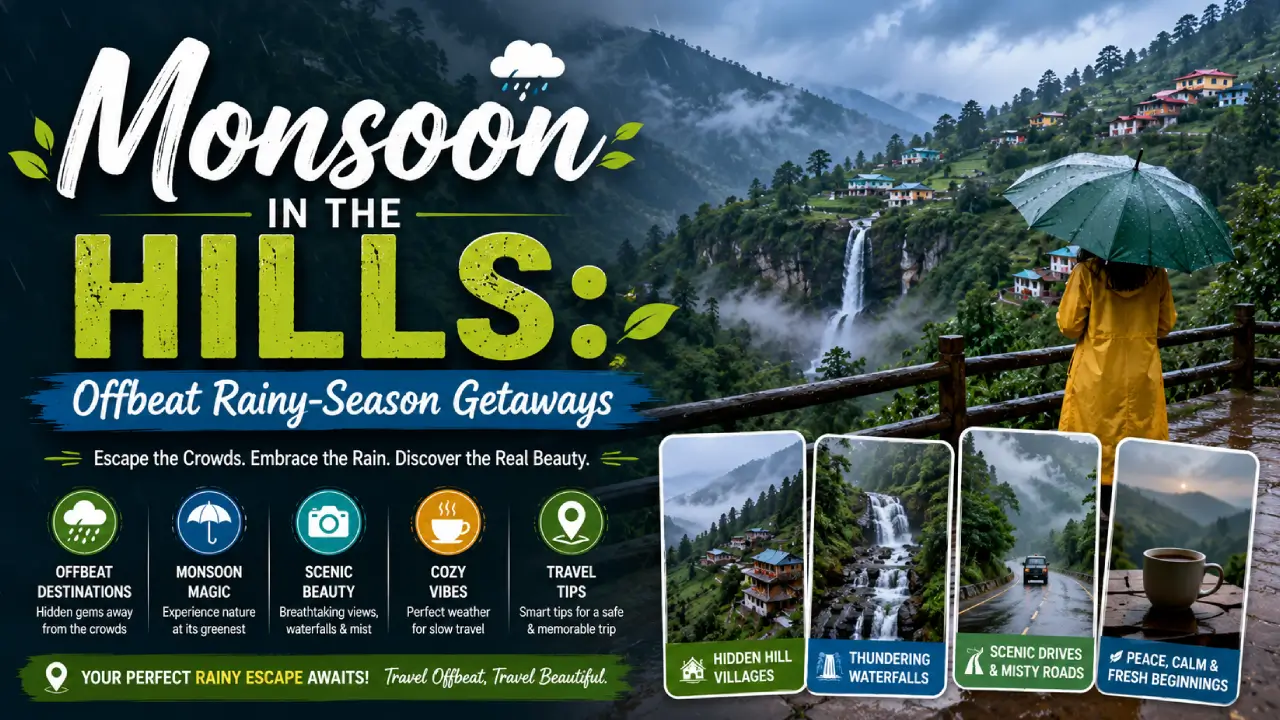
Where the Mountains Come Alive: The Magic of Monsoon in Uttarakhand
There’s a particular kind of magic that happens in the Himalayan foothills once the monsoon clouds roll in. The dusty brown slopes of summer turn an impossible shade of green overnight. Streams that were barely a trickle in May swell into thundering cascades. The air smells like wet pine and earth, and every ridge disappears into a soft curtain of mist. This is monsoon in Uttarakhand — arguably the most dramatic, most photogenic, and most underrated season to visit the state.
For backpackers, road-trippers, and weekend escapists from Delhi/NCR, monsoon season transforms Uttarakhand’s waterfalls into their most powerful, most spectacular versions of themselves. Rivers that trickle demurely in winter become roaring walls of white water. It’s the best time of year to chase falls — literally.
But let’s be honest upfront: monsoon travel in the hills isn’t without risk. Landslides, slippery trails, swollen rivers, and sudden weather shifts are real hazards between June and September. This guide will take you through the best waterfalls in Uttarakhand to visit this monsoon — along with the safety tips for monsoon travel you genuinely need before you go.
Top Waterfalls to Visit in Uttarakhand This Monsoon
Tiger Falls, Chakrata: The Secluded Giant
Tucked away near the sleepy cantonment town of Chakrata in Dehradun district, Tiger Falls is one of the tallest waterfalls in Uttarakhand, plunging roughly 312 feet down a sheer rock face into a natural pool below. What makes it special is how secluded it still feels — Chakrata has largely stayed off the mainstream tourist circuit, so you won’t be jostling for photo space here.
How to reach: Drive to Chakrata (about 90 km from Dehradun), then continue toward Kanasar village. From the parking area, it’s roughly a 4–5 km trek down a forest trail to reach the falls.
Why monsoon: The flow is at its most ferocious in July and August, and the surrounding deodar forest turns a lush, saturated green. Just note that the descent trail gets slick — this one demands sure footing.
Kempty Falls & Bhatta Falls, Mussoorie: Crowd-Pleasers with Good Reason
No list of Uttarakhand waterfalls is complete without Kempty Falls, Mussoorie’s most famous cascade. It’s touristy, yes — there are shops, changing rooms, and crowds — but the multi-tiered falls dropping from a height of nearly 40 meters are genuinely spectacular once the monsoon rains kick in. A short cable car ride or a walk down from the main road gets you right to the base.
Just a few kilometers away, Bhatta Falls offers a quieter, more nature-immersed alternative, set inside a small valley with terraced pathways and less commercial hustle — better suited if you’re traveling with family and want a calmer experience.
How to reach: Both falls are easily accessible from Mussoorie town, about a 5–6 hour drive from Delhi, making this a solid weekend-trip option.
Why monsoon: Water volume multiplies dramatically, and the surrounding hillsides are draped in fog and greenery — though this is also when the falls get their strongest currents, so caution is key (more on that below).
Corbett Falls, Ramnagar: A Peaceful Jungle Escape
If you’re craving quiet over crowds, Corbett Falls, near Ramnagar, offers a completely different monsoon experience. Set inside a forested patch close to Jim Corbett National Park, this modest but beautiful waterfall requires a short, easy walk through dense sal forest to reach — the kind of walk where you’re more likely to hear birdsong than tourist chatter.
How to reach: Located about 6 km from Ramnagar town, it’s an easy detour if you’re already headed toward Corbett for a jungle safari.
Why monsoon: The forest is at its most alive, with the added bonus that this area combines beautifully with a broader Corbett trip — think jungle drives paired with a peaceful waterfall walk.
Sahastradhara, Dehradun: The Thousand-Fold Spring
Sahastradhara, meaning “thousand-fold spring,” is less a single waterfall and more a network of sulfur springs and small cascades set within limestone caves just outside Dehradun. Locals and visitors alike come here for the sulfur water, believed to have therapeutic properties for skin conditions — the mildly pungent smell is a small price to pay for a dip many swear by.
How to reach: Just 14 km from Dehradun city center, making it an easy half-day trip, even for those short on time.
Why monsoon: The springs and streams swell with the rains, and the surrounding limestone cave formations look their most dramatic against the wet, green backdrop.
Vasudhara Falls, Badrinath: For the Serious Trekker
For travelers chasing something more adventurous, Vasudhara Falls, near Badrinath, rewards the effort with one of the most awe-inspiring sights in the region — water cascading nearly 400 feet down a sheer cliff, framed by snow-dusted peaks.
How to reach: From Badrinath, it’s roughly a 5–6 km trek (one way) via Mana village, India’s last village on the Indo-Tibet border. The trail is moderately challenging, involving boulder-strewn paths.
A word of caution: This one deserves special mention — Vasudhara sits at high altitude and the trail can be genuinely risky during heavy monsoon spells, with rockfall and landslide potential along the Badrinath route. Always check current road and trail conditions before attempting this trek in July or August; many trekkers prefer this one just after peak monsoon, in early autumn.
Offbeat & Hidden Waterfalls Worth Seeking Out
If you’d rather skip the crowds entirely, Uttarakhand has plenty of hidden waterfalls that rarely make it onto mainstream itineraries.
Patna Waterfall, Rishikesh: Tucked into the hills above Rishikesh, this lesser-known cascade requires a short trek through forest trails and rewards visitors with a private, untouched pool — ideal for travelers who’ve already ticked off Rishikesh’s more famous sights and want something quieter.
Shikhar Falls, Dehradun: A relatively unknown gem near Dehradun, Shikhar Falls sees a fraction of the footfall of Sahastradhara despite being just as scenic. It’s a great option if you’re road-tripping through the Doon valley and want a stop that feels like a genuine discovery rather than a checkbox.
Seeking out these offbeat spots is part of the joy of monsoon travel in Uttarakhand — fewer crowds, more solitude, and that satisfying feeling of having found something for yourself.
Crucial Monsoon Safety & Travel Tips
Monsoon in the Himalayas is stunning, but it’s also unforgiving if you’re unprepared. Keep this checklist handy before you set out:
- Check weather forecasts and landslide alerts daily — routes like Chakrata, Mussoorie, and especially the Badrinath highway are prone to sudden closures during heavy rain.
- Wear proper high-grip, waterproof footwear — flip-flops and smooth-soled shoes are a recipe for a fall on wet rocks and muddy trails.
- Never swim or wade into the base of a waterfall during heavy flow — currents are far stronger than they look, and water levels can rise suddenly upstream even if it’s not raining where you’re standing.
- Keep a safe distance from riverbanks and waterfall edges — flash floods are a real risk during the monsoon months.
- Avoid night travel on hill roads — visibility drops and landslide risk is highest after sustained rainfall.
- Pack a proper rain jacket, waterproof backpack cover, and a basic emergency kit — including a torch, power bank, ORS sachets, and any personal medication.
- Inform someone of your route and expected return time, especially for offbeat or trekking-adjacent waterfalls like Vasudhara or Tiger Falls.
- Keep local emergency and district helpline numbers saved before heading into remote areas with patchy network coverage.
- Build buffer days into your itinerary — monsoon road closures can add hours (or a full day) to your travel plans.
None of this is meant to scare you off — it’s meant to make sure the memories you bring back are the good kind.
Conclusion: Chase the Rain, Chase the Falls
Monsoon might not be the season most guidebooks recommend for Uttarakhand, but for those willing to travel a little smarter and a little more cautiously, it’s when the state’s waterfalls truly show off — swollen, thunderous, and framed by the greenest hills you’ll ever see. Whether it’s the secluded roar of Tiger Falls, the family-friendly splash of Kempty Falls, the quiet forest walk to Corbett Falls, the therapeutic springs of Sahastradhara, or the high-altitude drama of Vasudhara — there’s a monsoon waterfall in Uttarakhand for every kind of traveler.
So pack your rain jacket, check that landslide alert one more time, and go chase the falls.
Which Uttarakhand waterfall is on your monsoon bucket list? Drop a comment below and let us know — or if you’ve already got a trip planned, tell us where you’re headed! We’d love to hear about it.